Gutter installation in Florida has to be sized for the burst, not the yearly total. NOAA's rainfall-frequency estimates put a 10-year, 5-minute downpour at 9.55 inches an hour near The Villages and 11.3 at West Palm Beach. Before you hire gutter installers, ask which rain rate they sized for.
Florida's building code requires gutters with downspouts only where eaves project less than 6 inches, and every downspout must discharge at least 1 foot from the wall. Size the system for the 5-minute burst. Near The Villages that rain falls 2.4 times faster than the 1-hour rate the plumbing code designs for, so the same gutter drains well under half as much roof.
Some do by law; on the rest, gutters are a choice. The residential volume of the Florida Building Code says gutters with downspouts "are required on all buildings with eaves of less than 6 inches" of horizontal projection. Two exceptions are written in: gable end rakes, and a roof that sits above another roof. The Building volume repeats the rule in Section 1503.7.
That rule answers a common Florida search: why do so many houses here have no gutters? A home whose eaves reach 6 inches or more meets the code without them. On a new build with short eaves, the gutter decision belongs before the fascia and trim go up.
The rule sits in an unexpected place. R318.5 is in the code's chapter on subterranean termites, not the roofing chapter, and it also fixes where the water lands, covered under downspouts below.
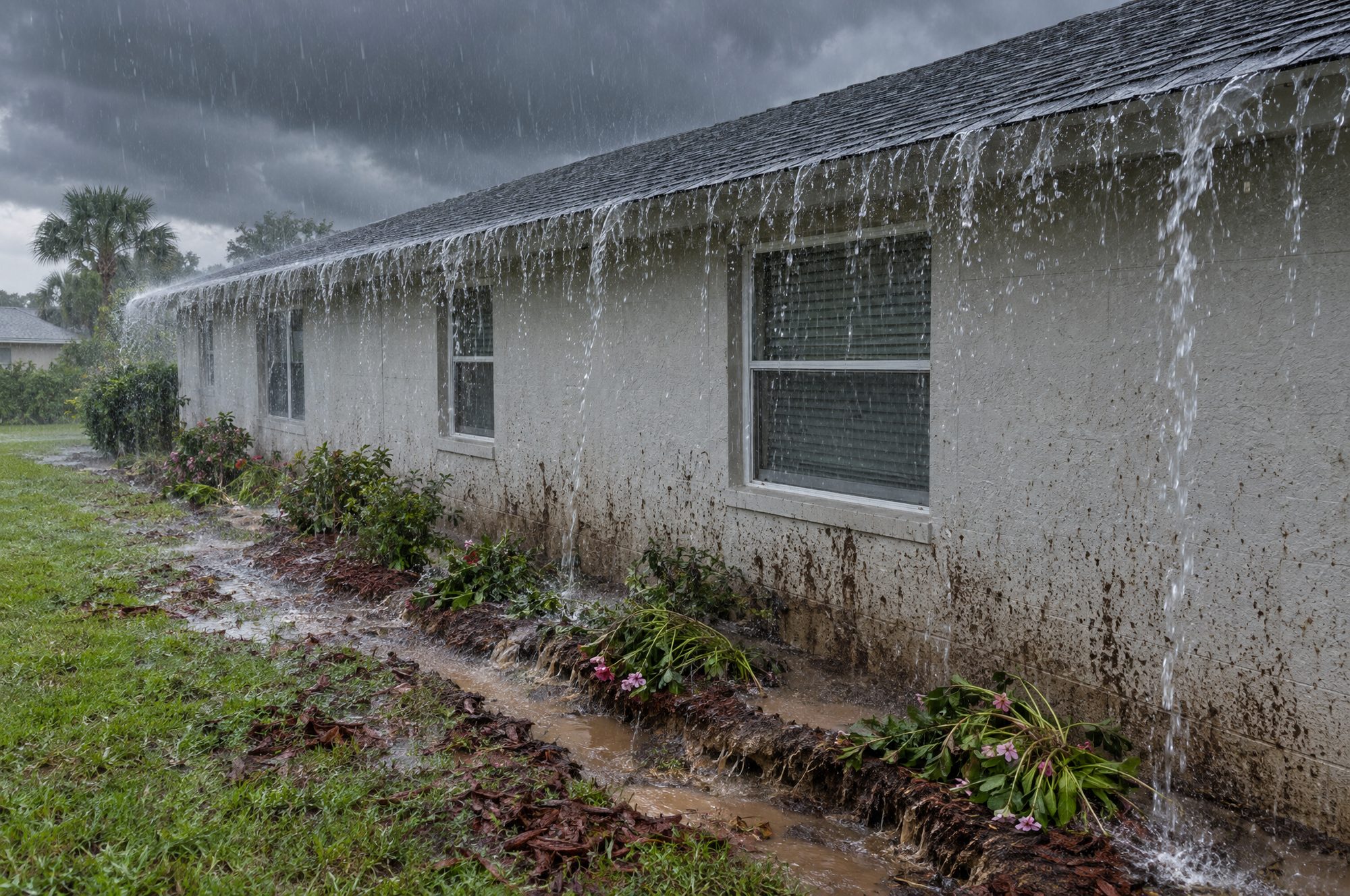
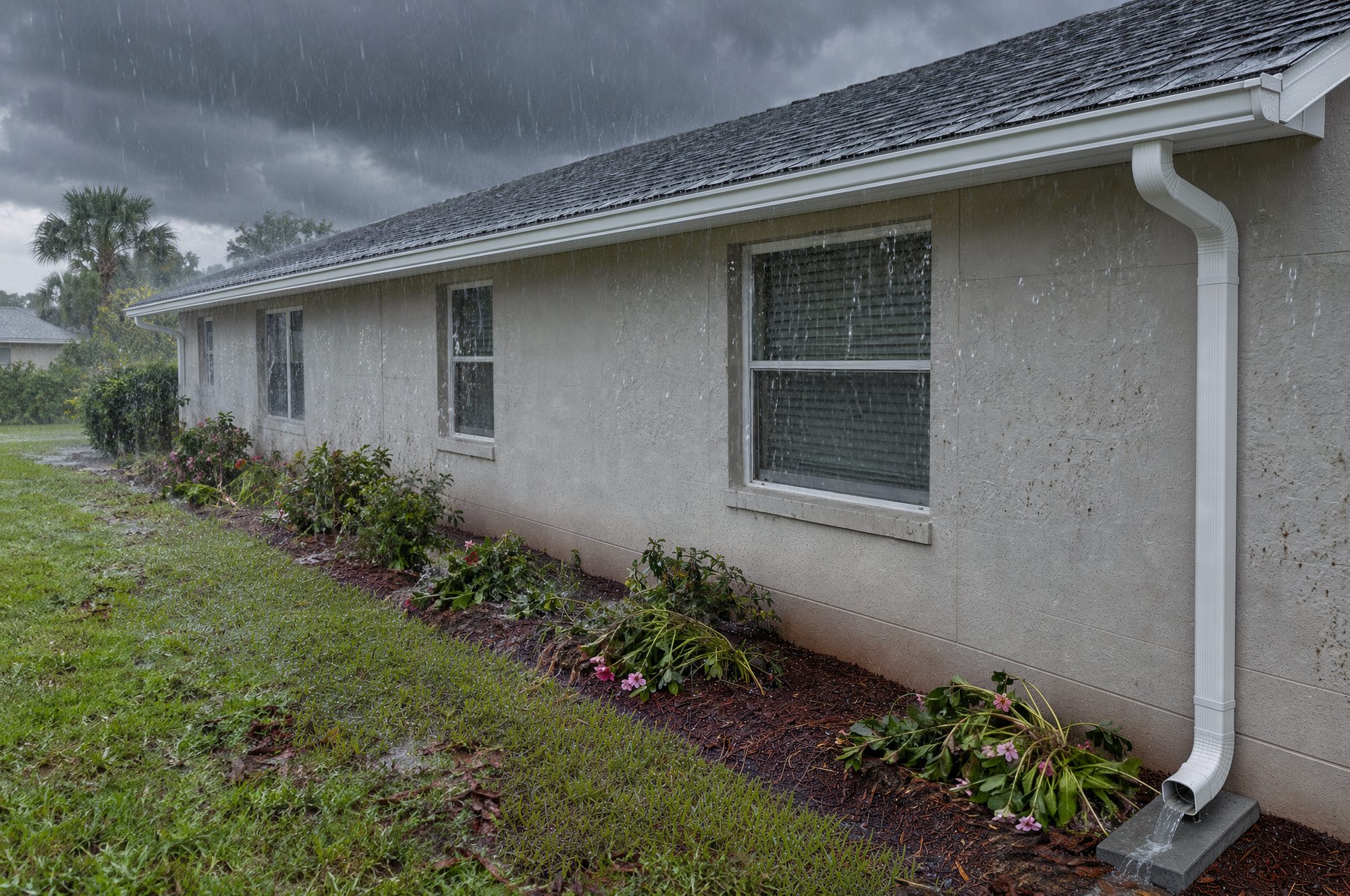
BeforeAfterIllustration
Illustration of the same downpour without and with a gutter. Not a South Fork Roofing job.
The weather
Florida rain is not ordinary rain
Gutters fail in the hardest five minutes of a storm, not over a year. Yearly totals only set the scene: NOAA's 1991-2020 normals give Miami International 67.41 inches a year and Orlando International 51.45, against 39.34 at Seattle-Tacoma.
The season matters more. Orlando's June normal is 8.05 inches and its November normal 1.79; June through September brings 29.57 inches, about 57 percent of the year. The Weather Service's Tampa Bay office defines the rainy season by near-daily thunderstorms, May 25 to October 10 across most of West Central Florida.
Intensity is the number a gutter feels. NOAA Atlas 14 estimates how hard rain falls over a set duration, for storms of a given rarity, at any point on the map. Here are ten points across the counties we serve:
Read the first column as your gutters' load. Near The Villages, a 10-year storm drops rain at 9.55 inches an hour for five minutes. By the USGS conversion below, that is close to 500 gallons in those five minutes off every 1,000 square feet of roof.
Your roof
How much water your roof sheds
The U.S. Geological Survey works one example: an inch of rain on a roof 40 feet by 70 feet adds up to 1,743 gallons. That comes to about 0.62 gallons for each square foot of roof per inch of rain, and it scales in a straight line.
Florida storms rarely stop at an inch. Atlas 14 puts the 10-year, 24-hour total at 6.13 inches near The Villages and 9.38 at West Palm Beach. On that same 40-by-70 roof, that is roughly 10,700 gallons in a day near The Villages and 16,300 at West Palm Beach.
Rain on your roof
7,638gallons run off that roof, all of it toward the gutters and downspouts.
Math: square feet × inches × 0.623 gallons.
Enter your roof's footprint and a rain depth, or keep the preset, the 10-year, 24-hour total near The Villages. Measure the area under the roof, overhangs and porches included, not the living area. Gallons are a total; gutters are sized from the rate.
Sizing
5-inch or 6-inch: how gutters should be sized
The plumbing code sets a method, not a size. FBC-Plumbing Section 1106.6 says horizontal gutters "shall be sized based on the flow rate from the roof surface." Flow depends on three inputs: the roof area draining to the run, the roof's pitch, and how hard the rain falls.
The code's Table 1106.6 rates half-round gutters at a slope of 1/8 inch per foot: a 5-inch carries 74 gallons a minute and a 6-inch carries 110, about 49 percent more. Downspouts, which the code calls leaders, range from 30 gallons a minute for a 2-by-2-inch pipe to 92 for a 3-inch round and 192 for a 4-inch round.
A gutter maker's SMACNA-based guide supplies the conversion: 96.15 square feet of roof under 1 inch an hour of rain makes 1 gallon a minute. On a pitched roof it multiplies the footprint by a pitch factor of 1.00 up to 3-in-12, 1.05 for 4 to 5, 1.10 for 6 to 8, 1.20 for 9 to 11 and 1.30 at 12-in-12.
Put together, the design rain rate decides everything. Below is the roof area each part can drain near The Villages, worked two ways. It is our arithmetic on the code table, the conversion and Atlas 14: not a code requirement, and not a design for your house.
The burst cuts every number by more than half. That gap is the case for 6-inch gutters and larger downspouts on big or steep roofs: a system that passes on the 1-hour method can still spill over in a summer cloudburst.
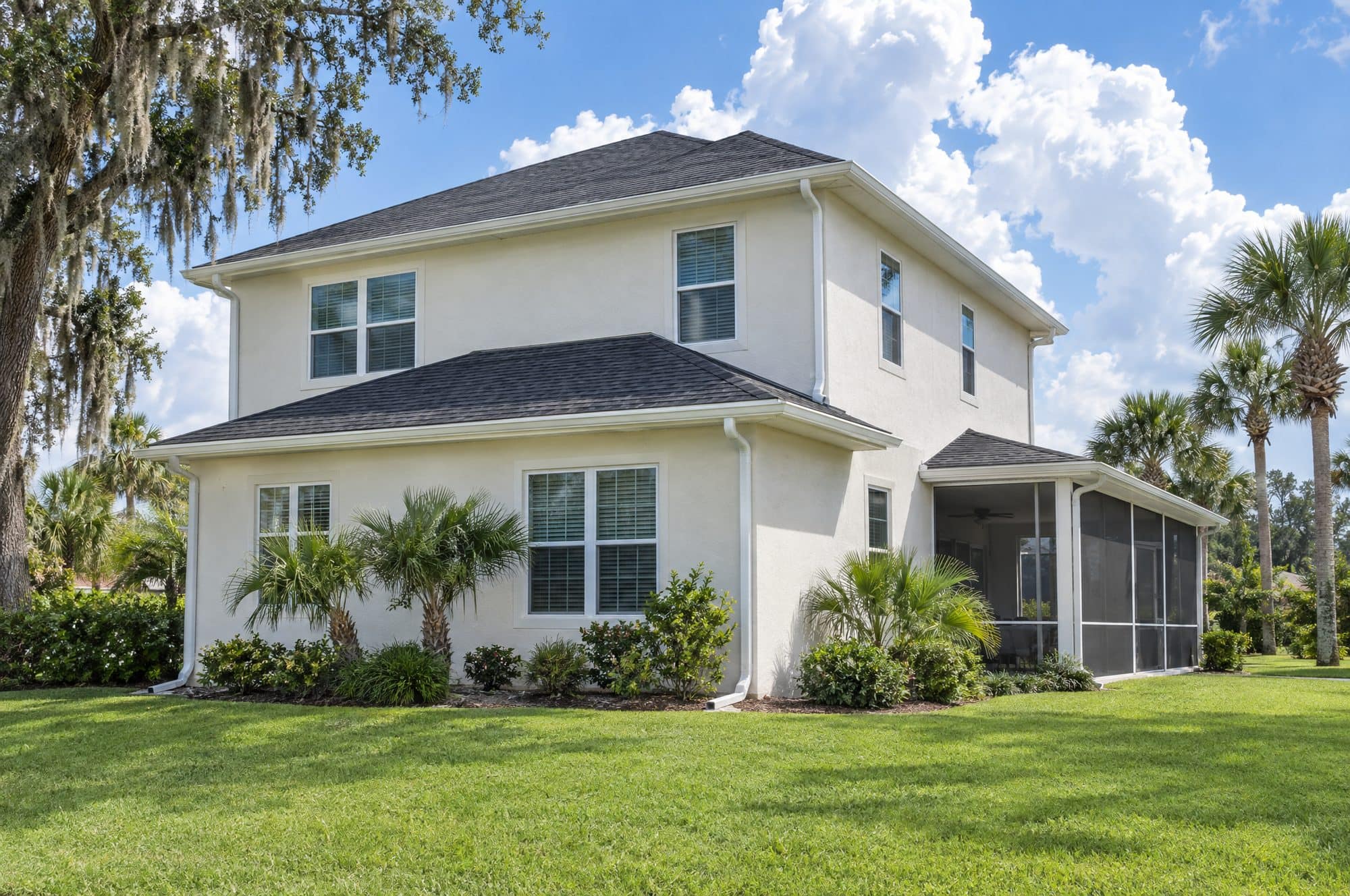
Illustration
A full gutter and downspout system on a two-story home
What about K-style gutters?
Five-inch K-style is the most common residential size, according to gutter-industry guides, and 6-inch is the usual step up. The code table covers only half-round and rectangular gutters. We looked for a K-style capacity table from the code, from SMACNA or from a maker's own test and did not find one.
So when anyone quotes a K-style capacity, ask which rain rate and which test it comes from. Until a maker shows tested numbers, the half-round rows above are the only code-rated reference for comparing sizes.
Whatever the gutter type, Florida's residential code sets the joint and fastener rules. Under R903.4.2, gutters and leaders are metal or a plastic accepted for outdoor exposure, their joints are lapped, soldered or caulked, and their fasteners resist corrosion and match the gutter metal. A SMACNA-based guide caps a run at about 50 feet between ends or expansion joints.
Profiles and materials
K-style or half-round, aluminum or copper
Half-round is the profile the code's capacity table covers, so a half-round system can be checked line by line against Table 1106.6. K-style is the more common residential profile in industry guides, but with no code table behind it, its sizing rests on the maker's data. Ask to see that data.
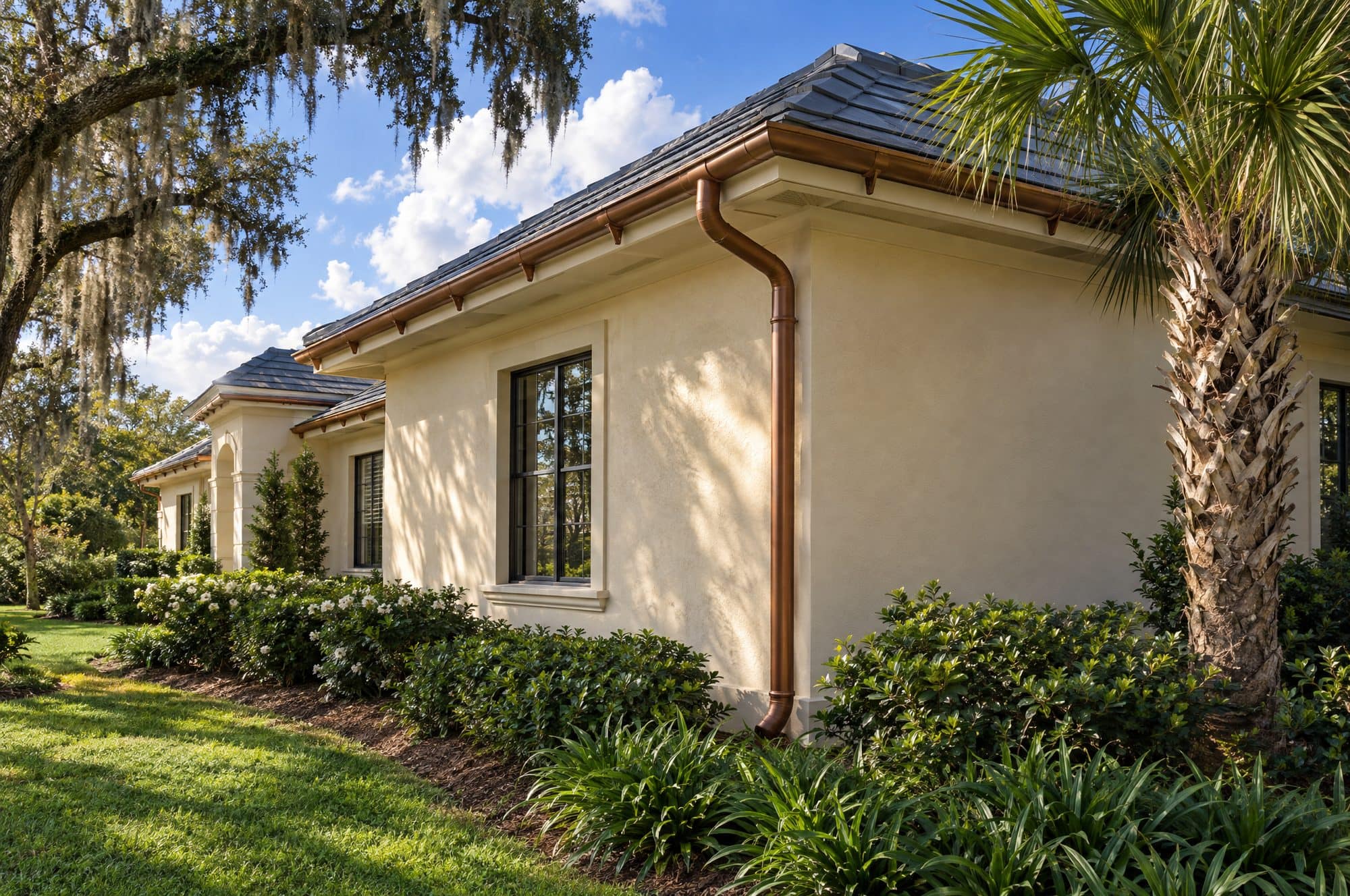
Illustration
Half-round profile on round hangers
Aluminum, copper, steel or vinyl
Salt air is the Florida test for any metal gutter. FEMA's coastal materials guidance says metal corrosion is most pronounced within about 3,000 feet of the ocean. One hanger maker's spec notes that aluminum resists salt-air corrosion, and the code requires fasteners of a similar or compatible material to the gutter (R903.4.2).
Color is the one choice made purely for looks, and it is easy to get wrong from a chip. Try white, bone, bronze, black or forest green gutters against a roof in our Design Studio, then check a real sample, because a screen only approximates paint.
Downspouts set two things: how fast a run empties, and where the water lands. On the second, the code is specific. Downspouts must discharge at least 1 foot from the wall, "whether by underground piping, tail extensions or splash blocks" (FBC-R R318.5). Where expansive or collapsible soils are known to exist, R801.3 sends roof water at least 5 feet from the foundation walls or into a drainage system that meets the code.
One downspout should serve no more than about 50 feet of gutter.
A downspout should not be wider than the bottom of the gutter it drains.
Downspouts under 7 square inches of opening are for small areas such as porches and canopies. A 2-by-3 is 6 square inches; a 3-by-4 is 12.
By that last rule, the 2-by-3 downspout is a porch size, not a main-roof size.
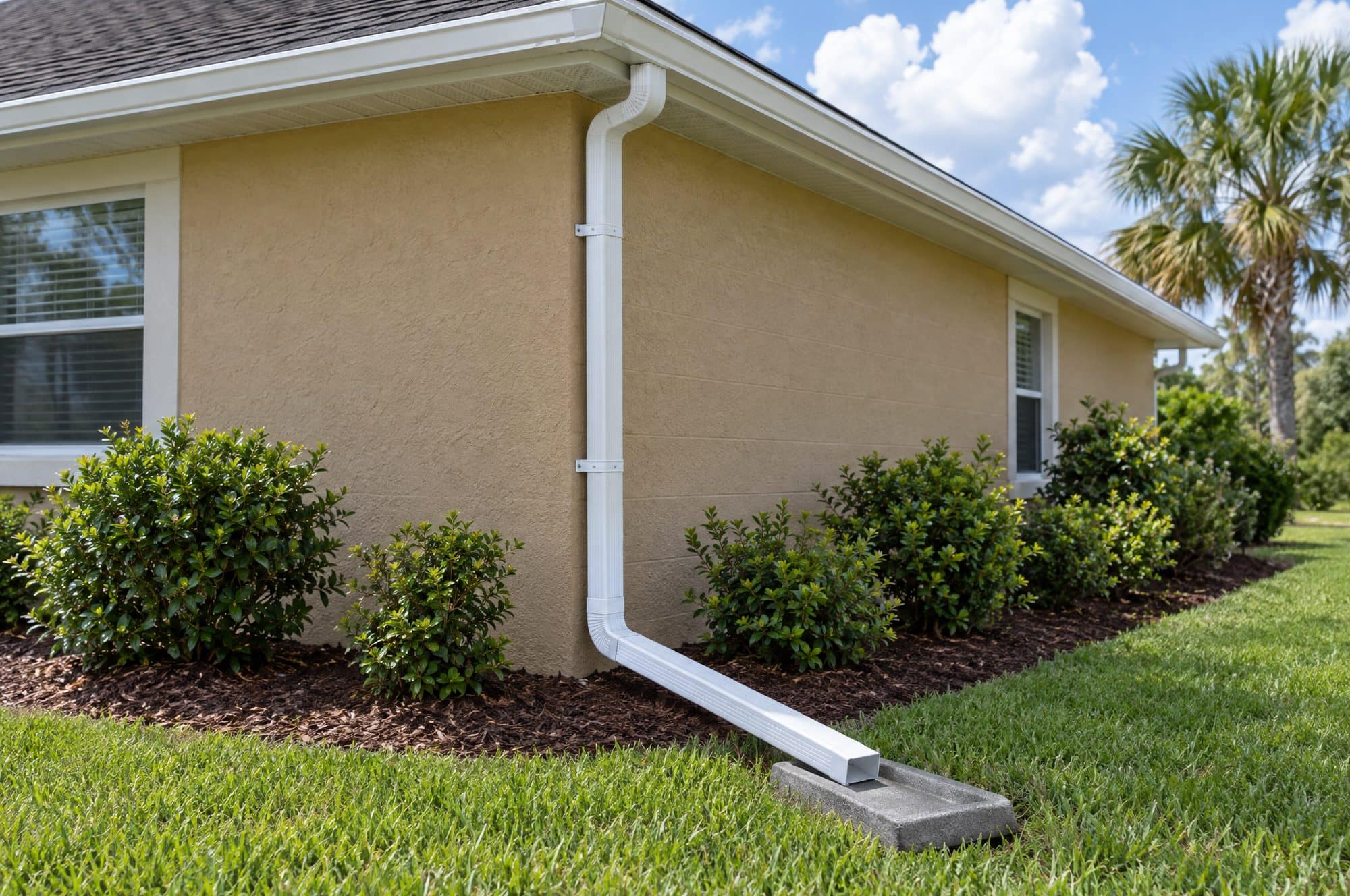
Illustration
Downspout, elbow, extension and splash block
How many downspouts? A worked example
Our arithmetic on the code table, the SMACNA conversion and Atlas 14 at The Villages. It shows the method; your roof's planes, valleys and outlet spots change the answer.
01
Design area
Take the USGS example roof, 40 by 70 feet, as a simple gable draining to its two 70-foot eaves at a 6-in-12 pitch: 2,800 square feet times 1.10 is 3,080 square feet.
02
Rain capacity
In the 5-minute burst, a 4-inch round or 3-by-4.25 downspout drains about 1,933 square feet, so the rain alone calls for at least two.
03
Run length
Each 70-foot eave is longer than the 50 feet one downspout should serve, so each needs a downspout at both ends: four in all.
04
Result
Here the run-length rule, not the rain, sets the count. With 3-inch round downspouts, the rain math alone reaches four.
Storms
Gutters in hurricanes: hangers and fasteners
Gutters are on the damage list from the first category up. NOAA's Saffir-Simpson scale names them among the parts a Category 1 hurricane, with sustained winds of 74 to 95 mph, can damage on well-built frame homes.
No section of the Florida code sets hanger spacing for houses; R903.4.2 says only that gutters be "securely fastened" with compatible, corrosion-resistant fasteners. Makers step in. One hidden-hanger maker lists 24 inches on center as standard and, for coastal and storm-prone areas, recommends 16-inch spacing with its clip and a #10 by 2-inch self-drilling screw.
On flat-roof buildings the gutter does structural work. Where a gutter secures the membrane edge of a low-slope roof, FBC-Building 1504.5.1 requires it to resist the code's wind loads and to be tested to SPRI GT-1 methods G-1 and G-2. There the gutter is part of the roof edge, not trim.
Roof edge
Fascia and soffit: the board behind the gutter
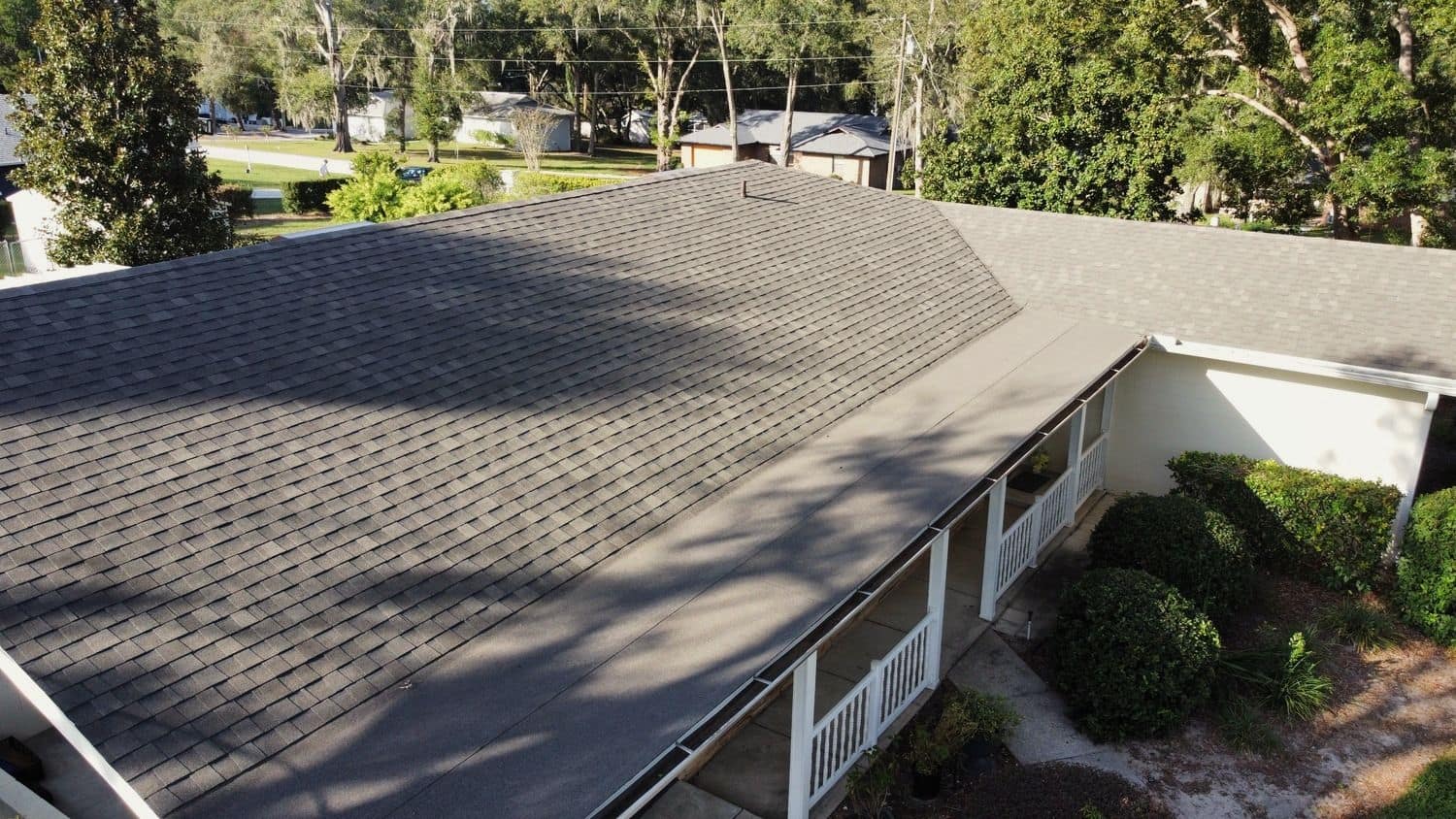
Gutters hang from the fascia, the board along the roof edge, so the two succeed or fail together. Stained or soft fascia behind a gutter is one of the plainest signs water has been getting past it.
Florida law ties fascia to roofing. A roofing contractor's scope includes "any repair or replacement of wood roof sheathing or fascia as needed during roof repair or replacement" (Fla. Stat. 489.105(3)(e)). The state's Specialty Structure contractor category lists "siding, soffit, fascia and gutters" side by side (Fla. Admin. Code R. 61G4-15.015).
Soffits matter in storms. After Hurricane Michael, FEMA found that wind damage to building envelopes let in costly wind-driven rain, noted that the 2007 Florida Building Code began requiring soffits to resist the same wind loads as walls, and recommended fastening soffit panels at both the wall and the fascia.
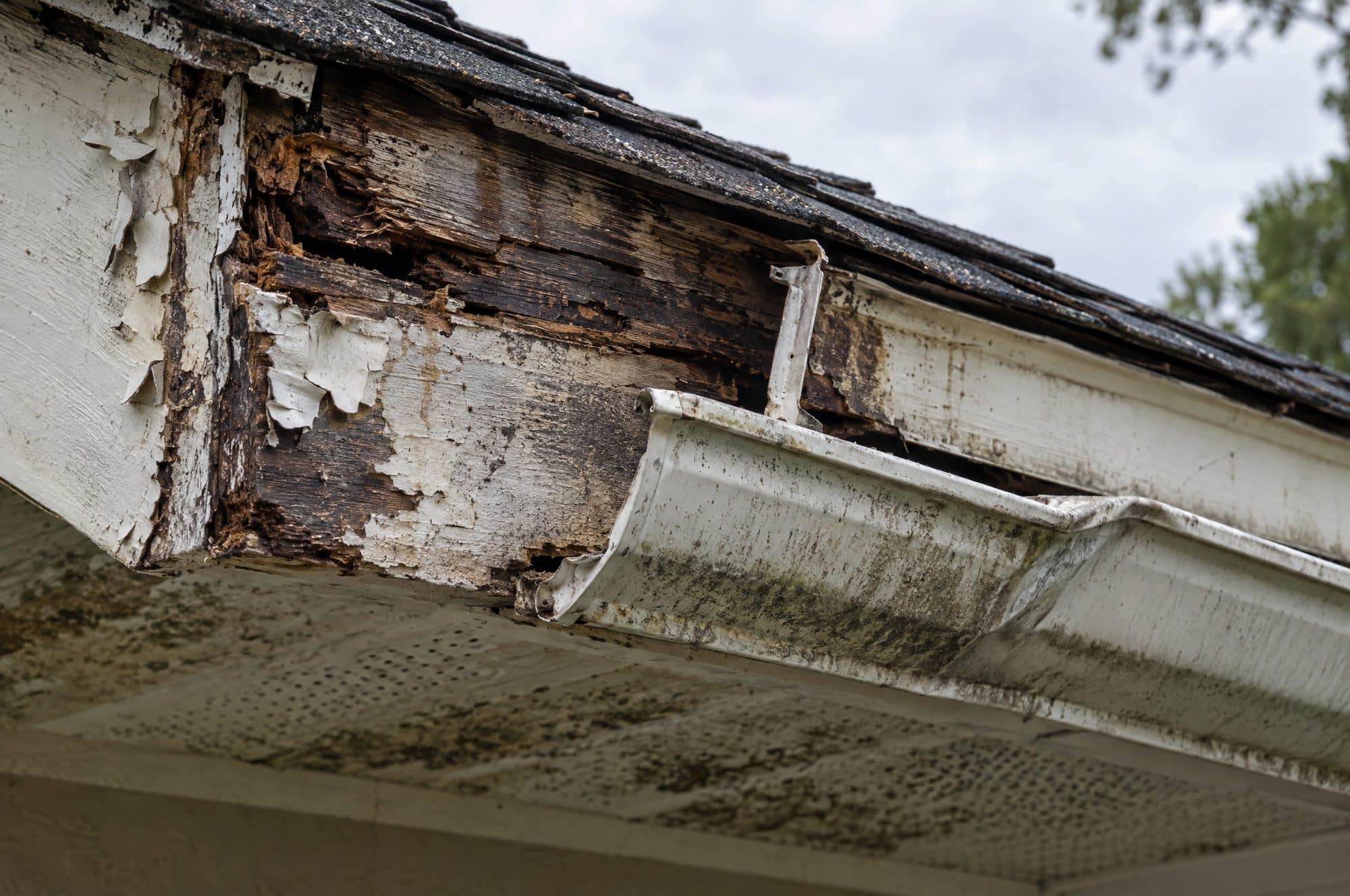
Illustration
Soft, stained fascia behind a sagging gutter
Upkeep
Oaks, pines and how often to clean gutters
Florida trees shed on a calendar, and the gutters under them clog on the same calendar. UF/IFAS describes the southern live oak as semi-evergreen, its fruit and leaves "a litter problem," and notes it grows new foliage about when it drops the old. Pollen season runs from January to June and peaks in March and April, with oaks, pines and melaleucas among the major producers. Pine needles fall hardest from September through November.
Tower Hill, a Florida home insurer, recommends cleaning gutters at least twice a year, typically spring and fall, and more often under overhanging trees or with frequent storms. NRCA pairs the same fall and spring roof checks with clearing gutters of dead leaves.
A calendar for a yard with oaks and pines. It is our synthesis of the sources above; no agency sets a Florida cleaning interval.
01
Late April to May
After the oaks' spring leaf drop and the pollen peak.
02
Before June
Clear the runs ahead of the June-to-September storm months.
03
Late November to December
After the autumn pine-needle fall.
04
After big storms
And more often under heavy canopy.
Guards
Gutter guards in Florida: what testing shows
No gutter guard ends the upkeep. A 2010 Consumer Reports test found fine mesh beat larger openings, but even the highest-scoring screen struggled in a severe downpour, and guards could still need brushing where pollen is heavy.
Repair or replace
Signs your gutters are failing
Most gutter trouble shows itself in a summer storm. This checklist ties each sign to a code or trade rule on this page; no agency publishes a Florida list.
Water sheets over the front at a corner or mid-run in a downpour: the run is undersized for the burst, or clogged.
A run sags or pulls away from the house: hangers have loosened, or the fascia behind them has softened.
Joints drip or separate: the code calls for lapped, soldered or caulked joints (R903.4.2).
A long run buckles at its seams: past about 50 feet, a gutter needs an expansion joint.
Fasteners rust or streak: a metal that does not match the gutter corrodes.
Fascia behind the gutter is stained or soft.
A downspout dumps against the wall, or less than 1 foot out (R318.5).
Heavy shingle granules collect in the gutter: an NRCA warning sign for the roof, not the gutter.
A loose hanger or one leaking joint is a small fix. An undersized system that spills over in every storm will not be cured by sealing joints, because its problem is capacity.
Roof and gutters together
Getting new gutters with a new roof
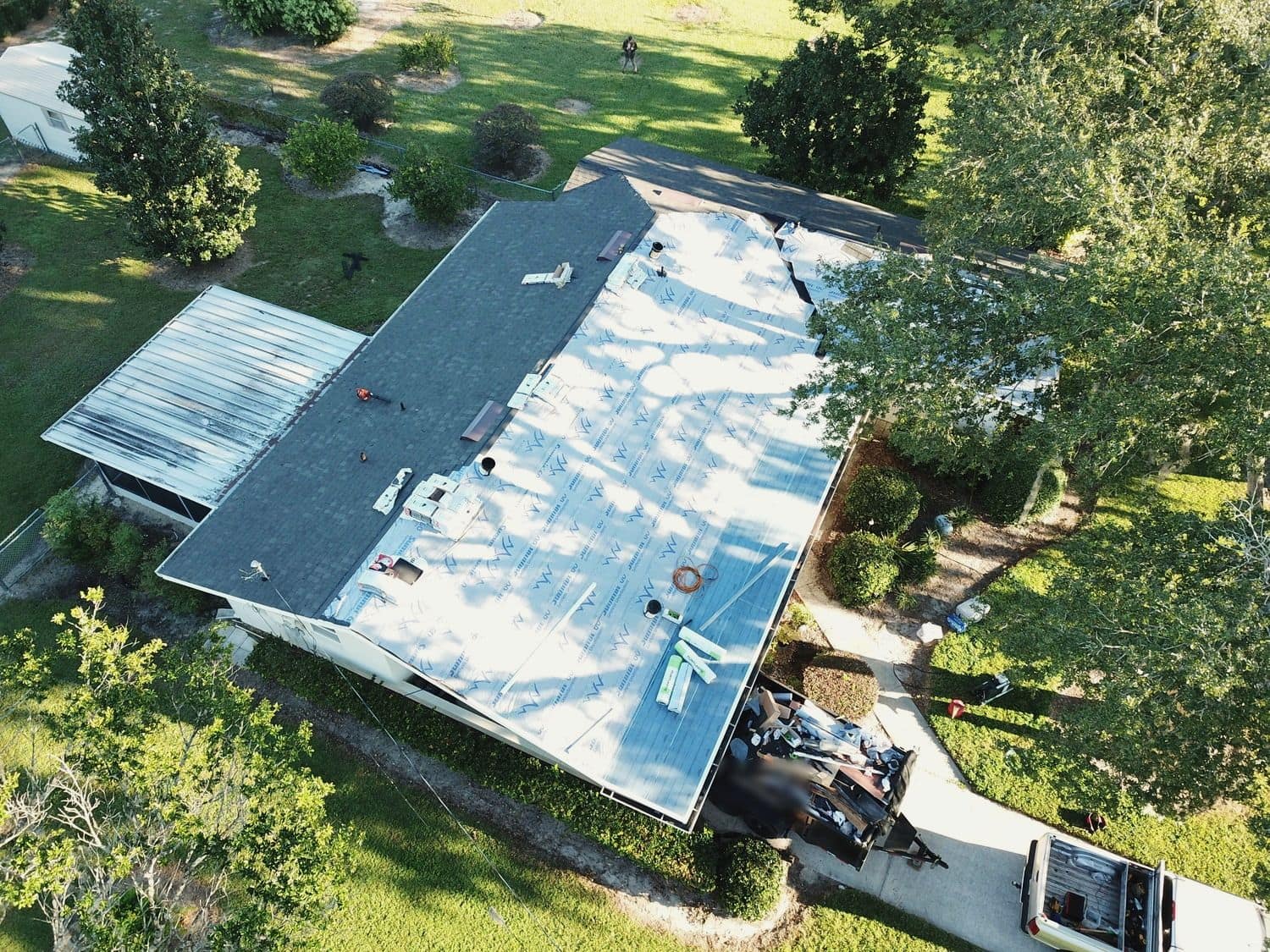
Re-roofs and gutters are two of the four services South Fork Roofing lists, so both can be priced in one request. Roof and gutter meet at the eave, and the code treats that edge with care.
On a shingle roof, FBC-Residential R905.2.8.5 requires drip edge at eaves and gables, laid over the underlayment and fastened no more than 12 inches apart, or 4 inches where the design wind speed (Vasd) is 110 mph or more or the mean roof height exceeds 33 feet. Rusted or damaged metal edging may not be reinstalled (R908.5).
The fascia behind that edge falls inside a roofing contractor's scope during a re-roof (489.105(3)(e)). Pricing the gutters at the same time lets the drip edge, the fascia and the new runs be planned as one roof-edge detail. See what a Florida re-roof involves on the roof replacement page.
This page prints no prices. Living area is not gutter length: what counts is the eave that drains, plus the downspouts down each wall, and a second story adds height to every downspout.
Your estimate
Tell us about your roof
Tell us about your home and your gutters, and we'll get back to you.
Ask your city or county building office before work starts; the answer is local. We found no statewide permit rule for gutters, and Florida's version of the code's work-exempt-from-permit section (105.2) lists no building exemptions, so do not assume gutters are exempt. The code still governs the work: downspouts discharge at least 1 foot from the wall (R318.5), and on homes the joints and fasteners must meet R903.4.2. Our county pages link each building office.
Because Florida's code requires them only on short eaves. FBC-Residential R318.5 calls for gutters with downspouts where eaves project less than 6 inches, except at gable end rakes and on a roof above another roof, so a house with deeper overhangs can legally shed rain off the edge. Optional is not the same as pointless. In June, Orlando's wettest month, the normal is 8.05 inches, and without gutters all of the rain that hits the roof leaves along the eave line.
Choose by roof area, pitch and the local burst rate, not habit. Five-inch K-style is the most common residential size in industry guides; 6-inch is the step up for large or steep roofs and heavy rain. In the code's half-round table, a 6-inch carries about 49 percent more than a 5-inch at the same slope. Near The Villages, the 10-year, 5-minute downpour runs at 9.55 inches an hour, and at that rate a 5-inch half-round run drains about 745 square feet of roof against about 1,107 for a 6-inch.
Not on age alone. InterNACHI's Florida chart puts aluminum gutters and downspouts at 15 to 35-plus years, copper at 40-plus, galvanized steel at about 15 and vinyl at 20-plus, so a 20-year-old aluminum system can still be sound. Judge condition instead: sagging runs, dripping joints, rusted or mismatched fasteners, soft fascia and overflow in ordinary storms. If it overflows because it is undersized, sealing joints will not fix it.
It depends on the contractor's scope, so ask what a gutter quote covers. Florida law puts fascia inside roofing work during a roof job: a roofing contractor's scope includes repairing or replacing fascia as needed during roof repair or replacement (Fla. Stat. 489.105(3)(e)). The state's Specialty Structure contractor category lists siding, soffit, fascia and gutters together (Fla. Admin. Code R. 61G4-15.015). If the board behind your gutters is soft, name it in the quote request so it is priced, not discovered.
Only your policy and your insurer can answer that, and a Florida contractor is not allowed to. Fla. Stat. 489.147 bars contractors from interpreting policy provisions or advising on coverage unless they are licensed as public adjusters, so this page will not guess. Ask your insurer or agent how your policy treats gutters. The law also sets a clock: notice of a new property claim must reach the insurer within 1 year after the date of loss; for a hurricane, that date is landfall or the date NOAA verifies the event (627.70132).
Do you need a contractor's license to install gutters in Florida?
Florida's rules place gutters inside a licensed contractor category, but we found no state guidance that settles every gutter-only job, so check locally. The Specialty Structure contractor scope lists "siding, soffit, fascia and gutters" (Fla. Admin. Code R. 61G4-15.015), and the roofing contractor scope covers fascia during a roof job (489.105(3)(e)). Look up anyone you hire in the state's public license search at myfloridalicense.com, and ask the local building office what it requires.
At least twice a year, and closer to three times under oaks and pines. Tower Hill, a Florida home insurer, recommends spring and fall at a minimum and more often under overhanging trees or with frequent storms. UF/IFAS puts pollen season from January to June, peaking in March and April, and pine needles fall most from September through November. That points to late spring, again before the June storm months, and once after the needles drop. No agency sets a Florida interval; that rhythm is our reading of the sources.
Should downspouts be buried or extended underground?
Either is allowed; the code cares about distance. FBC-Residential R318.5 requires downspouts to discharge at least 1 foot from the wall and names underground piping, tail extensions and splash blocks as ways to get there. Where expansive or collapsible soils are known to exist, R801.3 asks for 5 feet from the foundation walls or a drainage system that meets the code. Choose what suits your yard, then check after a heavy rain that the water really leaves the wall.
Nobody can promise that: NOAA's Saffir-Simpson scale lists gutters among the parts a Category 1 storm, at 74 to 95 mph, can damage on well-built frame homes. What you control is attachment. The code requires gutters to be securely fastened with compatible, corrosion-resistant fasteners (R903.4.2) but sets no hanger spacing for houses; one hanger maker recommends 16-inch spacing with a clip in coastal and storm-prone areas, against its 24-inch standard. The fascia behind the hangers has to be sound as well.
Should I replace my gutters when I replace my roof?
If the gutters are undersized, worn or hung on tired fascia, the re-roof is the sensible time, because the roof edge is being redone anyway. On a shingle roof the code requires drip edge at the eaves over the underlayment (R905.2.8.5), rusted or damaged metal edging may not go back on (R908.5), and fascia repair falls inside the roofing contractor's scope during the job (489.105(3)(e)). South Fork Roofing quotes re-roofs and gutters, so both can go in one request.
29.NOAA Atlas 14, Vol. 9 (Southeastern States) v2, partial-duration point estimates: The Villages area (28.93, -81.99), NOAA National Weather Service, Hydrometeorological Design Studies Center. Read Oct 5, 2026. 5-min intensity 10-yr 9.55 in/hr, 100-yr 13.4 in/hr; 60-min 100-yr 3.96 in/hr; 24-hr depth 10-yr 6.13 in, 100-yr 10.8 in. Intensity and depth pulled from the same endpoint (data=intensity and data=depth). Coordinates are an approximate town center, not an address.
30.NOAA Atlas 14, Vol. 9 (Southeastern States) v2, partial-duration point estimates: Ocala (29.19, -82.14), NOAA National Weather Service, Hydrometeorological Design Studies Center. Read Oct 5, 2026. 5-min intensity 10-yr 9.71 in/hr, 100-yr 13.7 in/hr; 60-min 100-yr 4.04 in/hr; 24-hr depth 10-yr 6.26 in, 100-yr 10.8 in. Intensity and depth pulled from the same endpoint (data=intensity and data=depth). Coordinates are an approximate town center, not an address.
31.NOAA Atlas 14, Vol. 9 (Southeastern States) v2, partial-duration point estimates: Gainesville (29.65, -82.32), NOAA National Weather Service, Hydrometeorological Design Studies Center. Read Oct 5, 2026. 5-min intensity 10-yr 9.20 in/hr, 100-yr 12.8 in/hr; 60-min 100-yr 4.08 in/hr; 24-hr depth 10-yr 5.81 in, 100-yr 9.65 in. Intensity and depth pulled from the same endpoint (data=intensity and data=depth). Coordinates are an approximate town center, not an address.
32.NOAA Atlas 14, Vol. 9 (Southeastern States) v2, partial-duration point estimates: Orlando (28.54, -81.38), NOAA National Weather Service, Hydrometeorological Design Studies Center. Read Oct 5, 2026. 5-min intensity 10-yr 8.71 in/hr, 100-yr 11.9 in/hr; 60-min 100-yr 3.93 in/hr; 24-hr depth 10-yr 6.10 in, 100-yr 10.2 in. Intensity and depth pulled from the same endpoint (data=intensity and data=depth). Coordinates are an approximate town center, not an address.
33.NOAA Atlas 14, Vol. 9 (Southeastern States) v2, partial-duration point estimates: Tampa (27.95, -82.46), NOAA National Weather Service, Hydrometeorological Design Studies Center. Read Oct 5, 2026. 5-min intensity 10-yr 9.61 in/hr, 100-yr 12.7 in/hr; 60-min 100-yr 3.96 in/hr; 24-hr depth 10-yr 6.24 in, 100-yr 11.3 in. Intensity and depth pulled from the same endpoint (data=intensity and data=depth). Coordinates are an approximate town center, not an address.
34.NOAA Atlas 14, Vol. 9 (Southeastern States) v2, partial-duration point estimates: Sarasota (27.34, -82.53), NOAA National Weather Service, Hydrometeorological Design Studies Center. Read Oct 5, 2026. 5-min intensity 10-yr 10.2 in/hr, 100-yr 13.7 in/hr; 60-min 100-yr 4.24 in/hr; 24-hr depth 10-yr 6.89 in, 100-yr 11.9 in. Intensity and depth pulled from the same endpoint (data=intensity and data=depth). Coordinates are an approximate town center, not an address.
35.NOAA Atlas 14, Vol. 9 (Southeastern States) v2, partial-duration point estimates: Melbourne (28.08, -80.61), NOAA National Weather Service, Hydrometeorological Design Studies Center. Read Oct 5, 2026. 5-min intensity 10-yr 10.6 in/hr, 100-yr 15.1 in/hr; 60-min 100-yr 4.37 in/hr; 24-hr depth 10-yr 7.48 in, 100-yr 13.1 in. Intensity and depth pulled from the same endpoint (data=intensity and data=depth). Coordinates are an approximate town center, not an address.
36.NOAA Atlas 14, Vol. 9 (Southeastern States) v2, partial-duration point estimates: West Palm Beach (26.71, -80.05), NOAA National Weather Service, Hydrometeorological Design Studies Center. Read Oct 5, 2026. 5-min intensity 10-yr 11.3 in/hr, 100-yr 16.6 in/hr; 60-min 100-yr 5.24 in/hr; 24-hr depth 10-yr 9.38 in, 100-yr 16.6 in. Intensity and depth pulled from the same endpoint (data=intensity and data=depth). Coordinates are an approximate town center, not an address.
37.NOAA Atlas 14, Vol. 9 (Southeastern States) v2, partial-duration point estimates: Fort Lauderdale (26.12, -80.14), NOAA National Weather Service, Hydrometeorological Design Studies Center. Read Oct 5, 2026. 5-min intensity 10-yr 10.9 in/hr, 100-yr 16.0 in/hr; 60-min 100-yr 5.58 in/hr; 24-hr depth 10-yr 9.32 in, 100-yr 16.3 in. Intensity and depth pulled from the same endpoint (data=intensity and data=depth). Coordinates are an approximate town center, not an address.
38.NOAA Atlas 14, Vol. 9 (Southeastern States) v2, partial-duration point estimates: Miami (25.77, -80.19), NOAA National Weather Service, Hydrometeorological Design Studies Center. Read Oct 5, 2026. 5-min intensity 10-yr 10.8 in/hr, 100-yr 15.7 in/hr; 60-min 100-yr 5.22 in/hr; 24-hr depth 10-yr 8.27 in, 100-yr 14.4 in. Intensity and depth pulled from the same endpoint (data=intensity and data=depth). Coordinates are an approximate town center, not an address.
41.Rainy season in West Central and Southwest Florida, NOAA National Weather Service, Tampa Bay Area office. Read Oct 5, 2026. May 25 to October 10 for most of West Central Florida; May 15 to October 15 for Southwest Florida.
71.Gutter Installation Cost (2025-10-28), HomeGuide. Read Oct 5, 2026. Published price guide. Its figures feed only the quote tool's labeled market range; this page prints no price.
72.Seamless Gutters Cost (2025-11-07), HomeGuide. Read Oct 5, 2026. Published price guide. Its figures feed only the quote tool's labeled market range; this page prints no price.
73.Gutter Installation Cost (updated 2026-07-09), Angi. Read Oct 5, 2026. Published price guide. Its figures feed only the quote tool's labeled market range; this page prints no price.
 Illustration
 Illustration
 Illustration
 Illustration