Gutters · Miami
Gutters in Miami, FL
Miami International Airport averages 67.41 inches of rain a year, and NOAA Atlas 14 puts Miami's 10-year, 5-minute burst at 10.9 inches an hour. Gutters in Miami have to be sized for that burst rather than the yearly total, and fastened to stand up to salt air near Biscayne Bay.
Updated October 2026
Local know-how
Sizing a Miami gutter for 10.9 inches an hour
Gutter sizing starts from flow. The Florida Plumbing Code's table rates a 5-inch half-round gutter at 1/8 inch of fall per foot at 74 gallons a minute and a 6-inch at 110, about 49% more. SMACNA-style sizing tables convert with one ratio: 96.15 square feet of roof under 1 inch an hour of rain sheds 1 gallon a minute.
Run Miami's 10.9-inch burst through that math and a 6-inch half-round run handles about 970 square feet of roof (110 × 96.15 ÷ 10.9), a 5-inch about 650. Steeper roofs count more area: multiply the flat footprint by 1.05 at a 4- or 5-in-12 pitch, up to 1.30 at 12-in-12. Downspouts set the other limit: a 3-inch round leader carries 92 gallons a minute and a 4-inch round 192.
The rarer storms are sharper still: Atlas 14 gives Miami 12.8 inches an hour for a 25-year burst and 15.8 for a 100-year one.
Salt air
Fasteners and hangers for bayside Miami
The Florida Residential Code's gutter rule, R903.4.2, asks for metal or approved plastic with lapped, soldered or caulked joints, fixed with corrosion-resistant fasteners compatible with the gutter. In Miami-Dade the HVHZ chapters govern roofs, but the corrosion point carries over: FEMA finds metal corrodes worst within 3,000 feet of the ocean, and soil along Brickell Bay Drive tested moderately to strongly saline after Irma.
One hidden-hanger maker recommends clips and 16-inch spacing in coastal and storm-prone areas, against its standard 24, and notes that aluminum resists salt air. Downspouts must discharge at least a foot from the wall, through pipe, tail extensions or splash blocks (R318.5).
Cleaning follows the rain. About 76.6% of the airport's normal rain falls from May through October, and June averages 10.51 inches. A Florida home insurer advises cleaning gutters at least twice a year, more under trees or after storms, which in Miami means once before June and again after the season peaks.
 Illustration
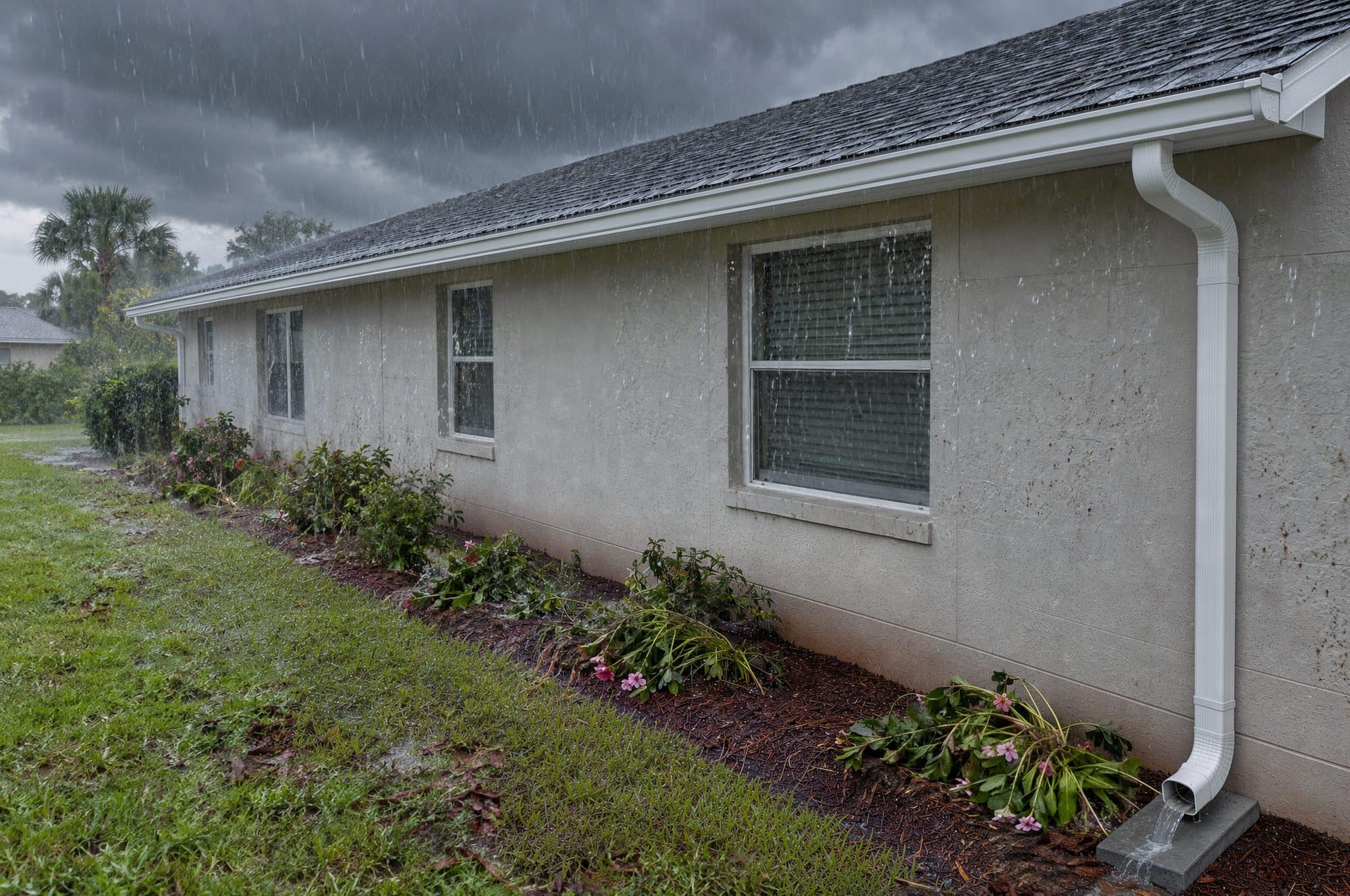
Illustration: a gutter carrying a summer downpour.
Rain on your roof
How much water a Miami roof sheds
Rain on your roof
Preset: 8.36 inches, the 10-year 24-hour rain (NOAA Atlas 14 at Miami).
10,417 gallons run off that roof, all of it toward the gutters and downspouts.
Math: square feet × inches × 0.623 gallons.
Questions
Gutters in Miami: questions
Do I want 5- or 6-inch gutters in Miami?
For most Miami roofs, the bigger size earns its keep. At Miami's 10-year, 5-minute rate of 10.9 inches an hour, a 6-inch half-round at 1/8 inch per foot handles about 970 square feet of flat roof footprint per run, against about 650 for a 5-inch. The yearly 67.41 inches at the airport matters less than that burst. Add a downspout wherever a run would carry more roof than its size allows.
Source: FBC-P 1106.6; Atlas 14.
Why do so many Miami homes have no gutters?
Because the code requires them only where eaves are short, and most Miami homes are not detached houses. The Florida Residential Code calls for gutters and downspouts when eaves project less than 6 inches, except at gable rakes or a roof above another roof. Just 22.4% of Miami's homes are detached houses, while 55.3% sit in buildings of 10 or more units. Where a house does have gutters, the downspouts must discharge at least a foot from the wall.
Source: FBC-R R318.5.
How often should Miami gutters be cleaned?
At least twice a year, and more under trees or after storms, per guidance from a Florida home insurer. In Miami the timing matters more than the count: June is the wettest month at 10.51 inches, and hurricane season peaks around September 10. A cleaning before the rains start and another in late fall keeps downspouts open for the burst storms that test them.
Source: Tower Hill (2025); NOAA.
Sources for this page(27)
- 1.Wikipedia, 'Miami' (revision 1376685952). Read Oct 5, 2026.
- 2.NOAA National Hurricane Center, Tropical Cyclone Report: Hurricane Irma (AL112017). Read Oct 5, 2026.
- 3.Single-family detached share of housing units: 22.4%. U.S. Census Bureau, American Community Survey 2024 5-year estimates (2020-2024), table B25024, via Census Reporter API. Read Oct 5, 2026.
- 4.Share of homes in buildings with 10+ units: 55.3%. U.S. Census Bureau, American Community Survey 2024 5-year estimates (2020-2024), table B25024, via Census Reporter API. Read Oct 5, 2026.
- 5.NOAA NCEI U.S. Climate Normals 1991-2020 (access data service). Read Oct 5, 2026.
- 6.NOAA NCEI U.S. Climate Normals 1991-2020 (access data service). Read Oct 5, 2026.
- 7.NOAA National Hurricane Center, Tropical Cyclone Climatology. Read Oct 5, 2026.
- 8.NOAA Atlas 14 (HDSC Precipitation Frequency Data Server). Read Oct 5, 2026.
- 9.NOAA National Centers for Environmental Information. Read Oct 5, 2026.
- 10.2023 Florida Building Code, Plumbing, 8th ed., Chapter 11 (UpCodes viewer, unofficial transcription). Read Oct 5, 2026. FBC text read from UpCodes (unofficial transcription): check floridabuilding.org or the ICC viewer before quoting (spec 8.7). Source URL inherited from COM-20 (the research cites it "as COM-20").
- 11.bergerbp.com. Read Oct 5, 2026.
- 12.2023 Florida Building Code, Residential, 8th ed., Chapter 9 (UpCodes viewer, unofficial transcription). Read Oct 5, 2026. FBC text read from UpCodes (unofficial transcription): check floridabuilding.org or the ICC viewer before quoting (spec 8.7). Source URL inherited from COM-29 (the research cites it "as COM-29").
- 13.Gutterall 6K hanger. Read Oct 5, 2026.
- 14.2023 Florida Building Code, Residential, 8th ed., R318.5 (UpCodes viewer, unofficial transcription); FBC-Building 1503.7. Read Oct 5, 2026. FBC text read from UpCodes (unofficial transcription): check floridabuilding.org or the ICC viewer before quoting (spec 8.7).
- 15.2023 Florida Building Code, Residential, 8th ed., Chapter 8 (UpCodes viewer, unofficial transcription). Read Oct 5, 2026. FBC text read from UpCodes (unofficial transcription): check floridabuilding.org or the ICC viewer before quoting (spec 8.7). Source URL inherited from NC-2 (the research cites it "as NC-2").
- 16.thig.com. Read Oct 5, 2026.
- 17.FEMA P-499 Technical Fact Sheet 1.7 , mirror. Read Oct 5, 2026.
- 18.NOAA Atlas 14 Volume 9 version 2, point precipitation frequency estimate at Miami's 2020 Census internal point, NOAA Hydrometeorological Design Studies Center. Read Oct 5, 2026.
- 19.City of Miami, Building Department, City of Miami. Read Oct 5, 2026.
- 20.NWS Miami, Weather Safety - Lightning. Read Oct 5, 2026.
- 21.2023 Florida Building Code, Building, 8th ed., Chapter 15 (UpCodes viewer, unofficial transcription). Read Oct 5, 2026. FBC text read from UpCodes (unofficial transcription): check floridabuilding.org or the ICC viewer before quoting (spec 8.7). Source URL inherited from C-14 (the research cites it "as C-14").
- 22.Florida Statutes, section 718.112 (2026). Read Oct 5, 2026.
- 23.Citizens Property Insurance Corporation. Read Oct 4, 2026.
- 24.Insp4pt 03 25. Read Oct 4, 2026.
- 25.miamidade.gov. Read Oct 5, 2026.
- 26.Florida Building Commission. Read Oct 5, 2026.
- 27.NOAA Atlas 14 at Miami: 10.9 in/hr (5-minute, 10-year). NOAA Atlas 14 Precipitation Frequency Data Server. Read Oct 5, 2026.
South Fork Roofing
Gutters in Miami
Answer a few questions about the job, or call.