Skip to content

Florida roof facts

20 Florida roof and storm facts

Florida has taken 121 direct hurricane hits since 1851, more than any other state, and those storms shaped how every roof here is built. Each fact below names its source, from NOAA and the National Weather Service to Florida's statutes, its building code and university research, with the date it was read.

Updated October 2026

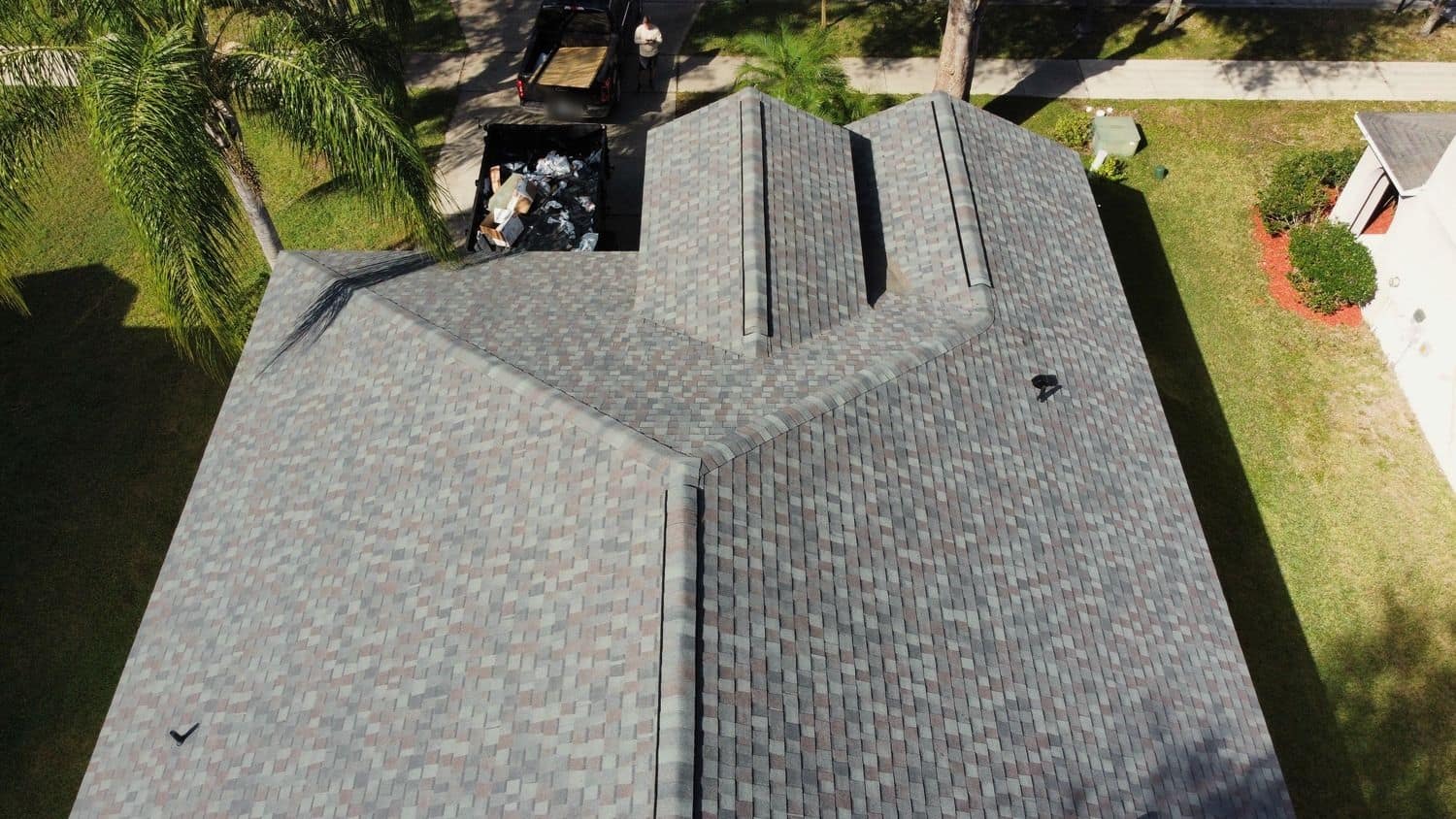
Top-down drone photo of a finished shingle roof

10 facts

Hurricanes

Fact 01

40%

Florida takes 40% of America's hurricanes

Of every hurricane that has struck the United States, forty percent hit Florida, according to NOAA's Hurricane Research Division. The lab also tallies the major ones, Category 3 and up: Florida and Texas together account for sixty percent of those strikes. No other state's roofs are asked to stand up to hurricane wind this often.

What it means for your roof: Wind sets the terms for a Florida roof, so ask how a new one will be fastened at its edges and its deck.

Source: NOAA Hurricane Research Division, Hurricane FAQ, read Oct 5, 2026

Fact 02

121

121 direct hurricane hits since 1851

NOAA keeps a running count of the hurricanes that made a direct hit on each state's mainland coast. Between 1851 and 2024 Florida took 121 of them, and 38 were major storms of Category 3 or stronger. Texas and Louisiana share second place with 64 apiece, so Florida's total comes close to double either one.

What it means for your roof: The storm and insurance rules that touch your roof are in the FAQ, each answer with its source.

Source: NOAA Hurricane Research Division, Hurricane FAQ, read Oct 5, 2026

Fact 03

Sept. 10

Hurricane season peaks on September 10

Officially, the Atlantic season opens on June 1 and closes on November 30. The National Hurricane Center puts its statistical peak on September 10, with most of the activity packed between mid-August and mid-October. That makes the months before June, and the first weeks of the season, the calmer stretch of the year for planned roof work.

What it means for your roof: If your roof is due, booking the work before mid-August keeps it clear of the busiest storm weeks.

Fact 04

14 · 7 · 3

A typical season: 14 named storms, 7 hurricanes, 3 major

Averaged over 1991 to 2020, an Atlantic season produces 14 named storms, according to the National Hurricane Center. Half of them, seven, grow into hurricanes, and three reach major strength at Category 3 or higher. Those figures count every storm in the Atlantic basin, not only the ones that reach Florida.

What it means for your roof: A look at the roof each spring catches lifted shingles and loose flashing while they are still small repairs.

Fact 05

74 mph

Even a Category 1 can damage shingles and gutters

A Category 1 hurricane on NOAA's Saffir-Simpson scale carries sustained winds of 74 to 95 mph. The scale's own description says that is enough to damage the roof, shingles, vinyl siding and gutters of a well-built frame home. At Category 3, from 111 to 129 mph, it warns that roof decking and gable ends can be torn away.

What it means for your roof: After any named storm, walk around the house and check the gutters and the shingle edges first.

Fact 06

3 of 4

Three of the four Category 5 landfalls since 1900 hit Florida

Only four hurricanes have come ashore in the United States at Category 5 strength since 1900: the 1935 Labor Day hurricane in the Florida Keys, Camille in 1969, Andrew in 1992 and Michael in 2018. Michael made landfall near Mexico Beach, Florida. That puts three of the four strongest landfalls of the last century and a quarter on Florida's coast.

What it means for your roof: Florida's code gives every address a design wind speed, and a new roof has to be built to it.

Source: National Weather Service Miami, Hurricane Andrew, read Oct 5, 2026

Fact 07

165 mph

Andrew: 165 mph and about 49,000 homes destroyed

Hurricane Andrew made landfall in South Florida on August 24, 1992, as a Category 5 with winds of 165 mph. The National Weather Service office in Miami counts about 49,000 homes destroyed in southern Dade County and about 108,000 more damaged. What the state changed because of that storm is the next fact on this page.

What it means for your roof: A re-roof on a house built before 2002 is done to today's code, not to the rules the house was first permitted under.

Source: National Weather Service Miami, Hurricane Andrew, read Oct 5, 2026

Fact 08

2002

Andrew is why Florida has one building code

Andrew showed how uneven Florida's patchwork of local building codes had become. The Legislature adopted a single statewide code in 1998, and the first Florida Building Code took effect on March 1, 2002, replacing every local code in the state. Since then a permit in Ocala and a permit in Tampa answer to the same statewide code, with an extra set of roof rules for Broward and Miami-Dade.

What it means for your roof: Every Florida re-roof permit is checked against this one code; the roof replacement page shows what it asks for.

Source: The Florida Senate, SB 808 (2026) staff analysis, read Oct 5, 2026

Fact 09

150 mph

Homes built to the modern code stood up to Hurricane Ian

Hurricane Ian came ashore in 2022 as a high-end Category 4 with 150 mph winds. FEMA's assessment team, as summarized by the International Code Council, did not observe wind-related structural damage to any home built after Florida adopted its statewide code. Roof coverings were another story: the most common damage the team found was at hips and ridges, on newer and older roofs alike.

What it means for your roof: Hips and ridges deserve a close look after a storm, even on a roof that is only a few years old.

Fact 10

1926

Adjusted for today, the costliest U.S. hurricane hit Miami in 1926

NOAA's hurricane researchers rank U.S. storms by damage adjusted to today's population, wealth and prices. On that list the costliest is not Andrew. It is the Great Miami Hurricane of 1926. The adjustment estimates what each storm would cost if it struck the same coast today, with every home and business now standing in its path.

What it means for your roof: Insurers ask how old your roof is; the FAQ explains Florida's roof-age rules and where they come from.

Source: NOAA Hurricane Research Division, Hurricane FAQ, read Oct 5, 2026

3 facts

The code

Fact 11

3 years

Florida updates its building code every three years

Under Fla. Stat. 553.73(7)(a), the Florida Building Commission has to adopt an updated Florida Building Code every three years. The 8th edition took effect on December 31, 2023. The 9th takes effect on December 31, 2026, and permit applications filed on or after that day must meet it, so two similar roofs can be held to different details depending on when their permits were filed.

What it means for your roof: If your re-roof permit will be filed late in 2026, ask which edition the job will be built to.

Source: Fla. Stat. 553.73(7)(a), the Florida Senate, read Oct 5, 2026

Fact 12

2

Two counties are their own hurricane zone

The Florida Building Code names exactly two counties as its High-Velocity Hurricane Zone: Broward and Miami-Dade. Homes there follow a separate chapter of roof rules instead of the residential roof chapter used in the rest of the state. Miami-Dade's Product Control Section reviews roofing products and issues Notices of Acceptance, known as NOAs, for those designed to meet the code.

What it means for your roof: In Broward or Miami-Dade, ask for the NOA or Florida product approval number of any roof system you are quoted.

Fact 13

Exempt

A roof the Florida Building Code leaves alone

Chickees, the open-sided wooden huts with thatched roofs of palm or palmetto built by the Miccosukee and Seminole Tribes of Florida, are exempt from the Florida Building Code. The carve-out sits in the code's first chapter, where its scope is set. A shingle, metal or tile re-roof gets no such pass: it needs a permit, a sheathing inspection and a roofing inspection.

What it means for your roof: See what each re-roof inspection checks, from the sheathing nails to the flashing.

2 facts

Water and gutters

Fact 14

1,743 gal

One inch of rain puts 1,743 gallons on a roof

The U.S. Geological Survey did the math: one inch of rain on a 40-by-70-foot roof adds up to 1,743 gallons. All of it has to leave by the gutters and downspouts or over the roof edge, and in Florida it can arrive fast. NOAA's Atlas 14 puts the 10-year, five-minute burst at 8.71 to 11.3 inches an hour across ten points in the state.

What it means for your roof: Gutter size should follow your roof area and your local rain rate; the gutters page works through the math.

Source: U.S. Geological Survey, Rain and Precipitation, read Oct 5, 2026

Fact 15

gutta

Gutter comes from the Latin word for a drop

The word gutter reached English through the Old French goutiere, from the Latin gutta, meaning a drop. Its sense of a trough under the eaves that carries off rainwater dates from the mid-1300s. So for well over six centuries, English speakers have had a word for the job a Florida gutter does in every summer storm: moving drops off the roof before they cause trouble.

What it means for your roof: Florida's code wants downspouts to empty at least a foot from the wall, by extension, pipe or splash block.

Source: Online Etymology Dictionary, gutter, read Oct 5, 2026

5 facts

Roofs

Fact 16

Algae

Those black streaks on the roof are alive

The dark streaks on so many Florida roofs are not dirt or soot. The Asphalt Roofing Manufacturers Association identifies them as algae, most often a species called Gloeocapsa magma, carried on the air. ARMA's bulletin says the staining is most widespread in the Gulf States and in warm, humid areas, and it warns that high-pressure washing is likely to damage asphalt roofing.

Fact 17

25%

The 25% rule: how much of a Florida roof can be patched

Florida's residential code says no more than 25 percent of a roof or roof section may be repaired, replaced or recovered in any 12-month period unless the covering on that whole roof or section is redone to code. Fla. Stat. 553.844(5) adds an exception: if the existing roof was built or replaced under the 2007 code or later, only the repaired part has to meet today's code. Neither text says an insurer must pay for a full roof.

What it means for your roof: Before a large repair, find out which code edition your roof was last built to; it changes what the permit requires.

Fact 18

29%

A white roof cut cooling energy by about 29%

In July 2000, Florida Power & Light and the Florida Solar Energy Center measured cooling use in identical test homes in Fort Myers fitted with different roofs. Over the test period, the home with a white metal roof used 29.4 percent less cooling energy than the one with dark shingles. The full report also gives an adjusted figure for that house: 24 percent for July 8 to 31.

What it means for your roof: Roof color is a real choice in Florida. Try light and dark looks on a real house in the Design Studio.

Source: Florida Solar Energy Center, FSEC-CR-1220-00, read Oct 5, 2026

Fact 19

~2×

The right nail nearly doubles a roof deck's hold

The FORTIFIED Roof standard from the Insurance Institute for Business & Home Safety calls for ring-shank nails in place of smooth ones, set in an enhanced pattern to hold the roof deck down. IBHS says that switch nearly doubles the deck's strength against wind. Florida's code has its own re-nailing table for re-roofs, which adds fasteners wherever the old deck nails are too small or too far apart.

What it means for your roof: On a re-roof, ask what the deck will be nailed with, and at what spacing, before the old roof comes off.

Source: IBHS FORTIFIED, FORTIFIED Roof, read Oct 5, 2026

Fact 20

4 years

Shingles can quietly come unglued

University of Florida engineers aged asphalt shingles artificially, then tested them in hurricane-strength wind. Beyond the first four years after installation, the shingles tended to become partly unsealed, especially at the exposed corners. The researchers advise checking adhesion at shingle edges and hand-sealing loose ones to the maker's instructions. FEMA's Hurricane Michael advisory cites a Florida study that found unsealed shingles among the sources of failure.

South Fork Roofing

Tell us about your roof.

CallGet a quote