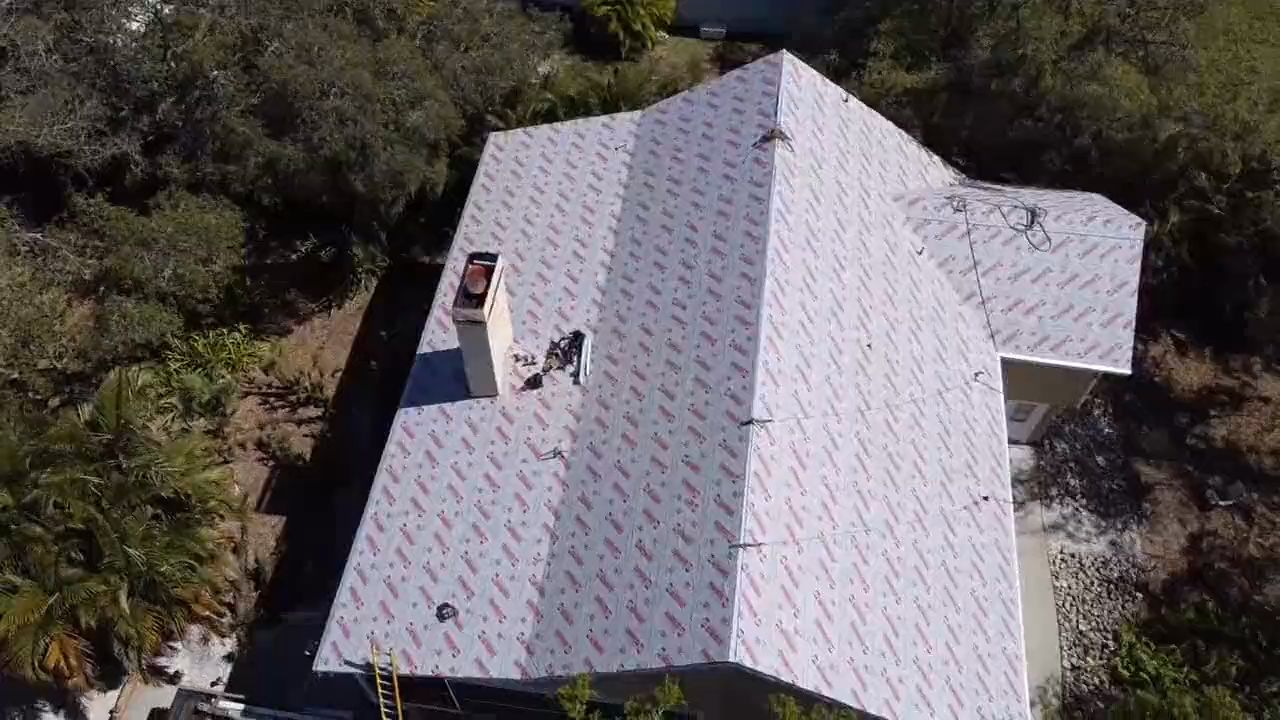
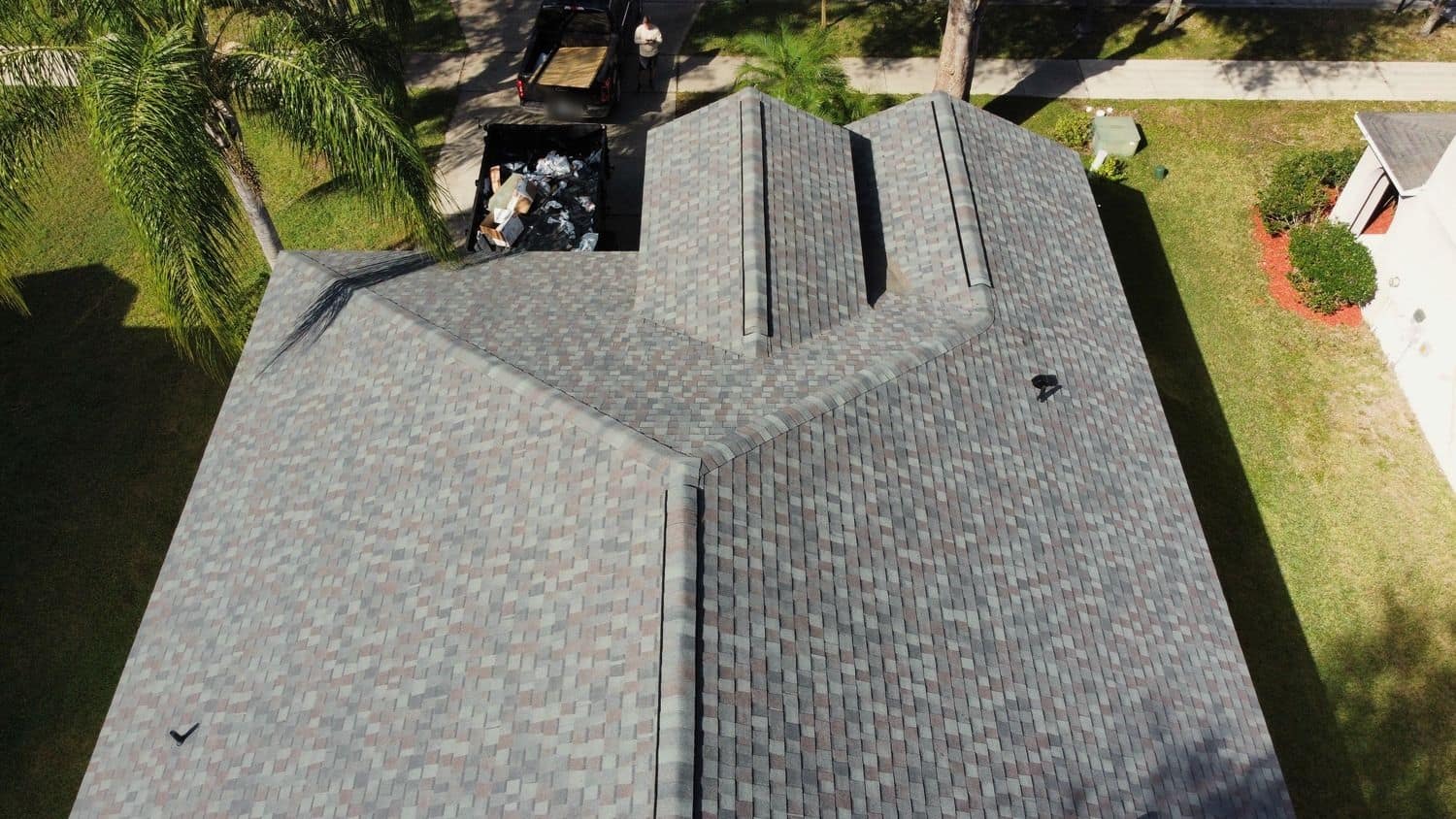
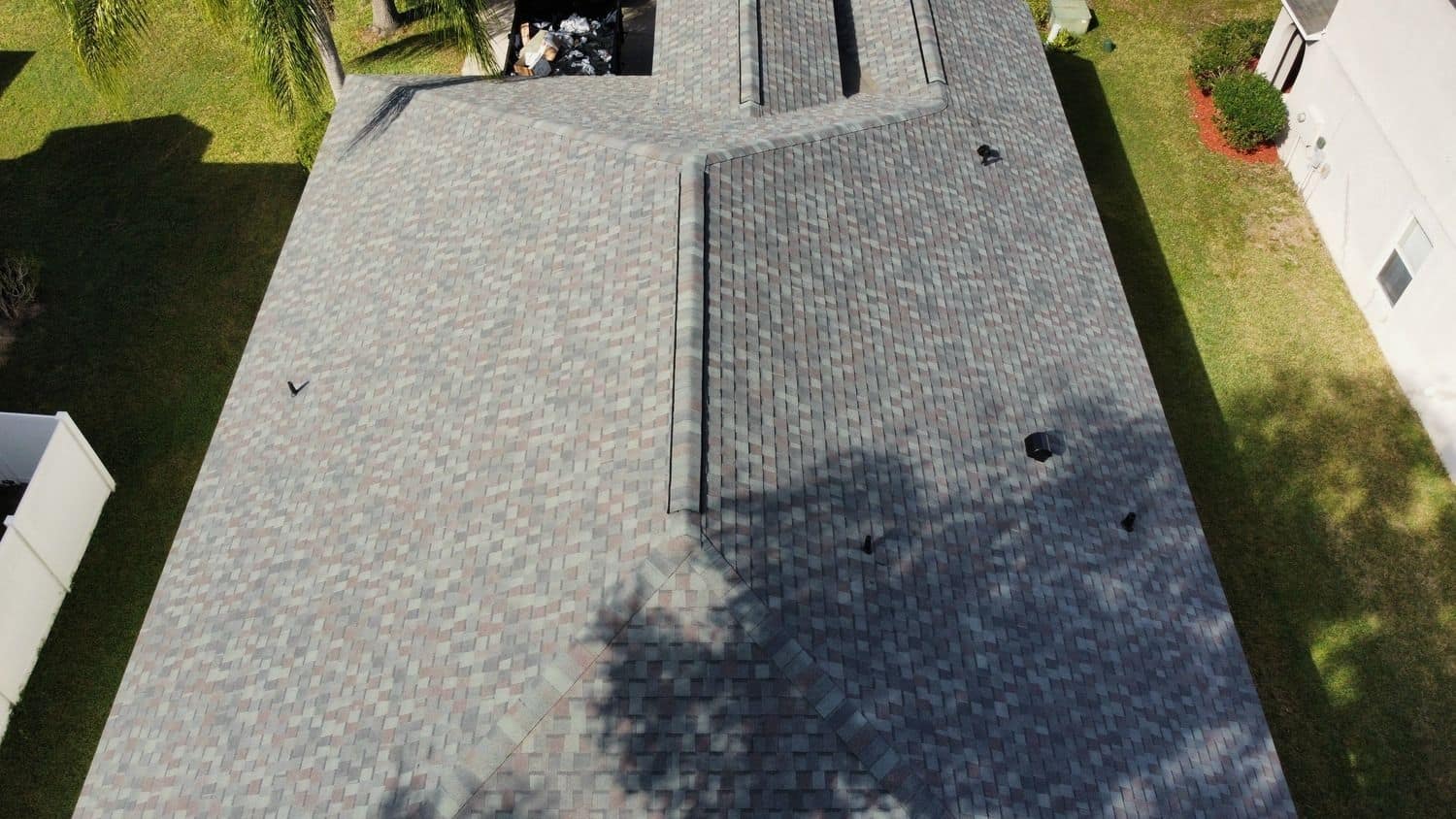
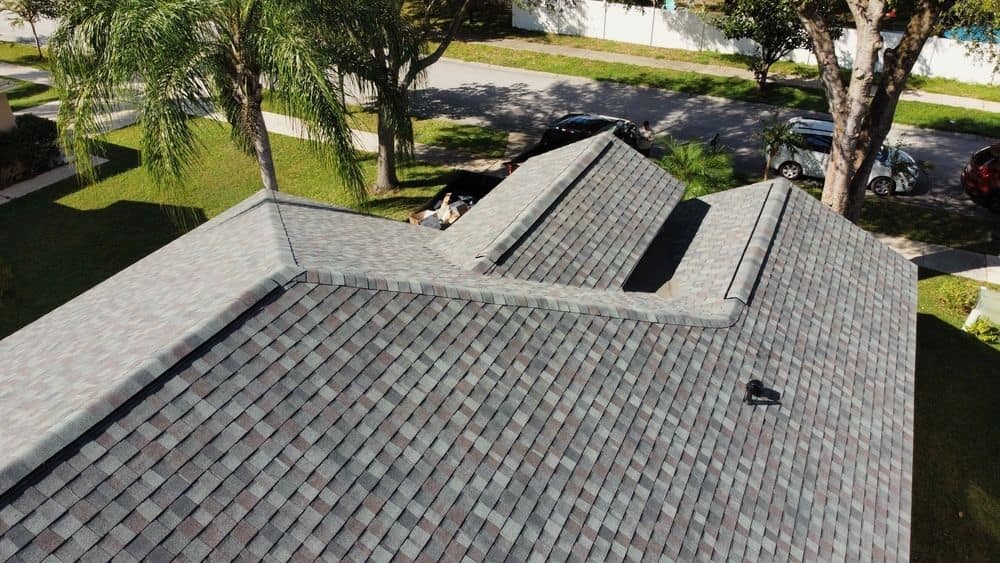
Roof replacement in Florida is permitted code work, not just new shingles. Under the 2023 Florida Building Code, an inspector checks the roof sheathing and its fasteners, then the new covering and flashing. Homes permitted before the statewide code also need their deck nailing brought to a set schedule and a secondary water barrier.
A Florida re-roof needs a permit but skips plan review (FBC-B 105.1, 107). The building official inspects the sheathing and fasteners, then the roofing (110.3). Homes permitted before the statewide code must meet a deck-nailing schedule and add a secondary water barrier (R908.7). On a roof that predates the 2007 code, repairing more than 25% of it in 12 months means redoing the whole roof or roof section (R908.1.1).
The Florida Building Code has exact words for this work. Reroofing, its umbrella term, means “the process of recovering or replacing an existing roof covering,” and it covers two different jobs.
Roof replacement, the tear-off: “removing the existing roof covering, repairing any damaged substrate and installing a new roof covering.”
Roof recover, the layover: a new covering over a prepared old one “without removing the existing roof covering.”
A shingle tear-off runs in this order, and your building department sets the inspection dates.
01
Permit
Required, though reroofs skip plan review (FBC-B 105.1, 107).
02
Tear-off
The old covering comes off to the deck, and damaged sheathing or fascia is fixed (Fla. Stat. 489.105).
03
Deck nailing
Homes permitted before the statewide code get supplemental fasteners wherever theirs fall short of Table R908.7.1.2.
04
Sheathing inspection
Sheathing and fasteners are checked at dry-in or on a separate visit (FBC-B 110.3).
05
Underlayment and metal
A code underlayment method, then drip edge and flashing; rusted metal may not be reused (R908.5).
06
New covering
Installed to its product approval and the maker's instructions.
07
Roofing inspection
Dry-in, insulation, roof coverings and flashing, at a minimum (110.3).
Tear-off day
Timing
Signs your roof is due for replacement
Start with what Citizens, Florida's state insurer, asks inspectors to record on a roof. Its list includes cracking, curling, heavy granule loss, exposed felt, missing or loose tabs or tiles, soft decking, hail marks, and leaks in the attic or on ceilings.
Some wear hides from the yard. University of Florida researchers reported in 2014 that after about four years, asphalt shingles tended to come partly unsealed, mostly at exposed corners.
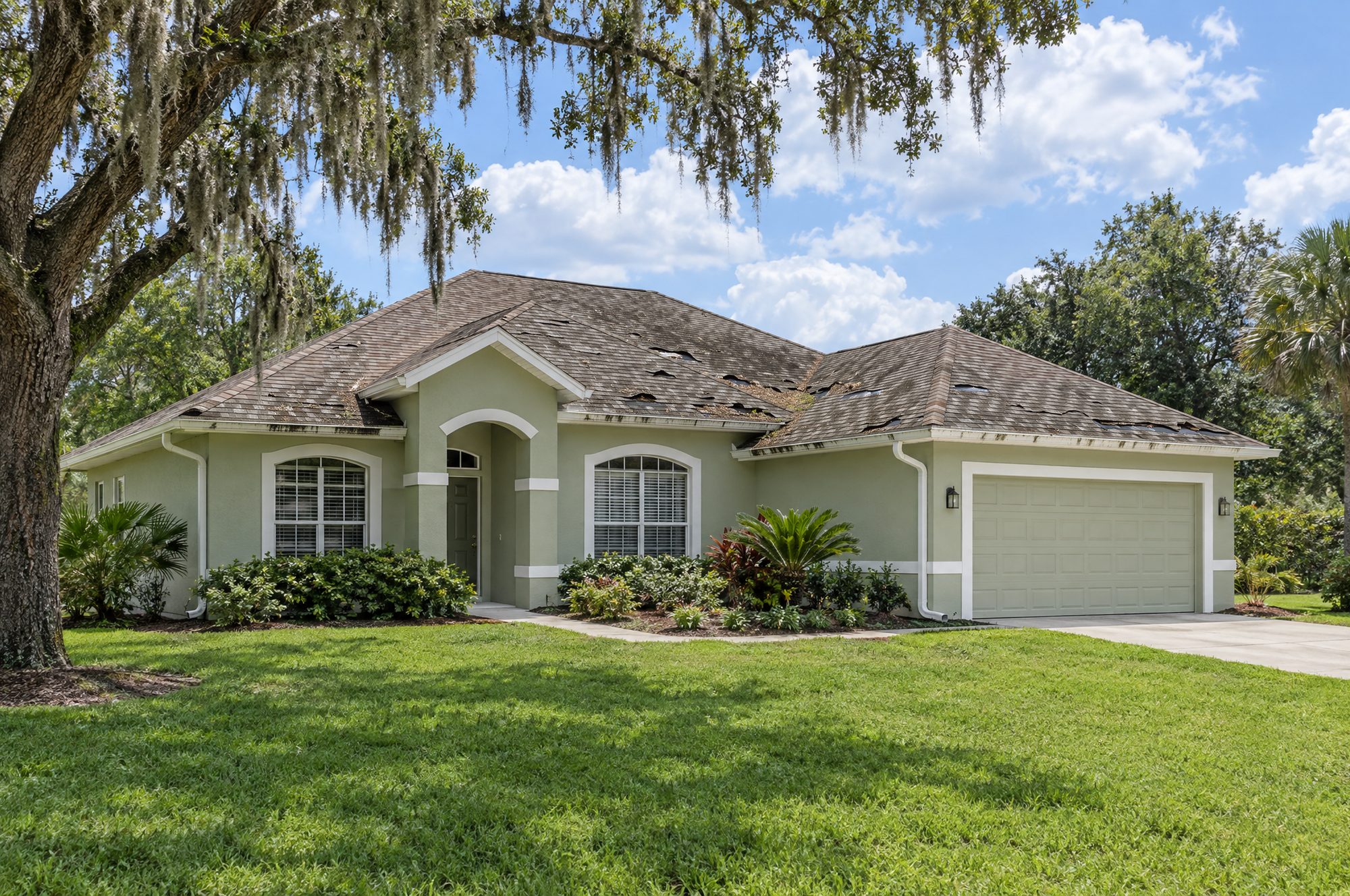
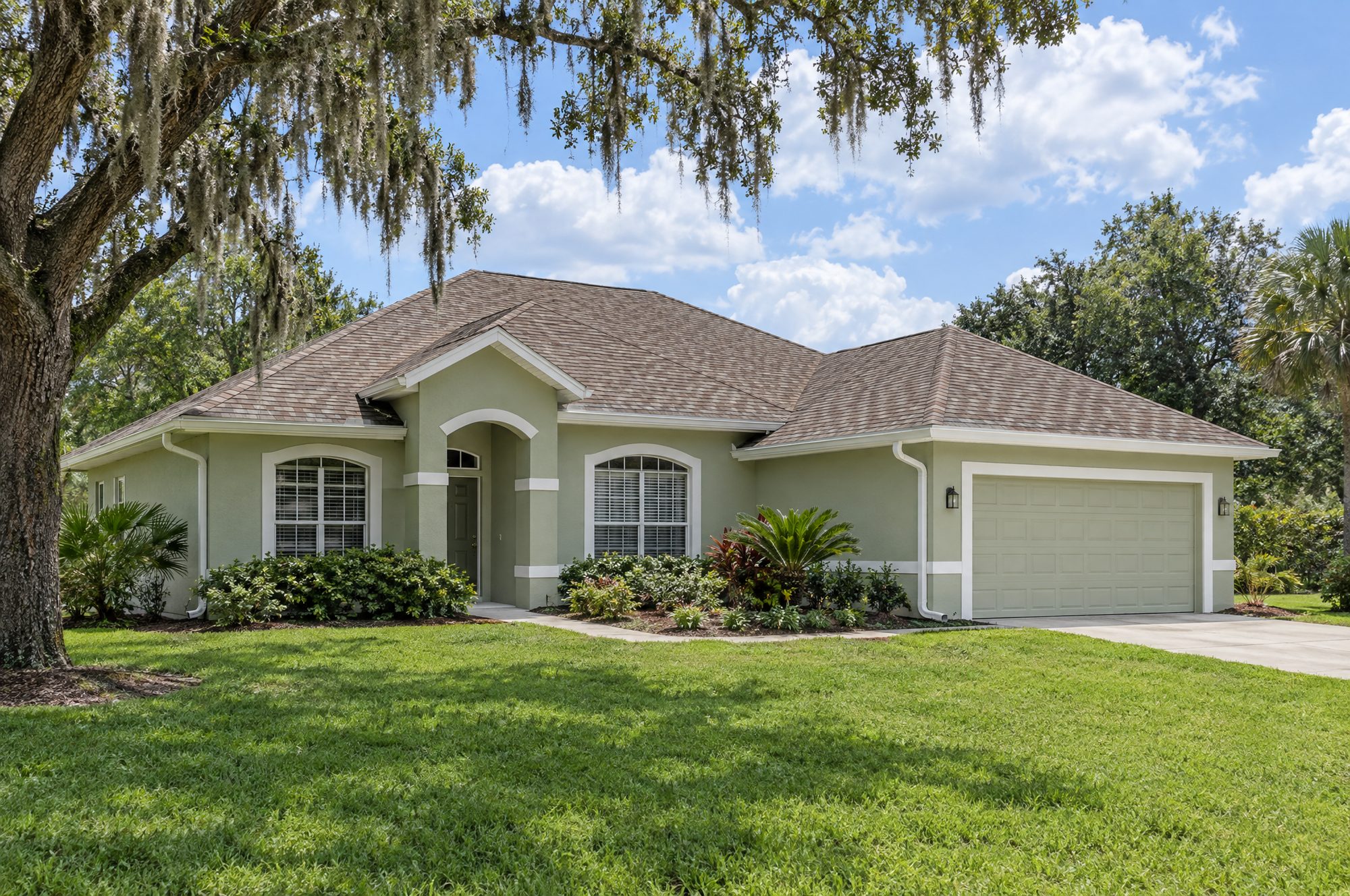
BeforeAfterIllustration
Illustration of what a re-roof changes. Not a South Fork Roofing job.
Florida code
The code items that make a Florida re-roof different
Four code items shape the parts of a Florida re-roof you never see once the covering is on.
Deck attachment and re-nailing
When a covering is removed and replaced on a home with a wood deck, the deck attachment must meet R908.7.1. Staples or 6d nails get supplemental fasteners every 6 inches or closer, and so do 8d nails spaced wider than 6 inches. Homes permitted under the Florida Building Code, first in force March 1, 2002, are exempt.
A secondary water barrier
State law ordered reroof rules adding a secondary water barrier and stronger deck attachment to site-built single-family homes by October 1, 2007 (Fla. Stat. 553.844(3)(a)). For shingle and metal roofs, R905.1.1.1 allows three methods:
Self-adhering membrane (ASTM D1970) over the whole deck.
A 3-3/4-inch strip of that membrane, or AAMA 711 Level 3 tape, over every deck joint, plus underlayment over the whole roof.
Two layers of felt or synthetic underlayment with capped ring-shank nails, and metal caps at 170 mph and up.
Insurers draw a sharper line. The state wind mitigation form says “Standard underlayment or hot-mopped felts do not qualify as an SWR” (OIR-B1-1802). After Hurricane Michael, FEMA found a secondary seal can significantly cut water entry when the covering is lost, and IBHS puts the cut at up to 95%.
Drip edge
Shingle roofs need drip edge at eaves and gables, over the underlayment, fastened at most 12 inches apart, or 4 inches where the design wind speed (Vasd) is 110 mph or more (R905.2.8.5).
Product approval
Roofing products need statewide approval, and none may be marketed as hurricane or windstorm protection without it (Fla. Stat. 553.842(5)). Ask for each product's FL number and check it on the Florida Building Commission's search. Hurricane straps, by contrast, are required only in narrower cases, covered in the FAQ below.
Florida law
Florida's 25% roof rule and the 2007-code exception
The 25% rule limits patching, and it is often explained wrong. The rule itself sits in the code, at FBCR R908.1.1 and FBC-B 1511.1.1: “Not more than 25 percent of the total roof area or roof section of any existing building or structure shall be repaired, replaced or recovered in any 12-month period unless the roof covering on the entire existing roof system or roof section is replaced or recovered to conform to the requirements of this code.”
Its exception lives in state law. Section 553.844(5) of the Florida Statutes covers a roofing system or roof section that “was built, repaired, or replaced in compliance with the requirements of the 2007 Florida Building Code, or any subsequent editions of the Florida Building Code, and 25 percent or more of such roofing system or roof section is being repaired, replaced, or recovered, only the repaired, replaced, or recovered portion is required to be constructed in accordance with the Florida Building Code in effect.” Local governments may not amend that exception by ordinance.
Item
Roof last built or replaced before the 2007 code
Roof built, repaired or replaced to the 2007 code or later
Repairs on more than 25% within 12 months
The whole roof or section is replaced or recovered to current code (R908.1.1)
Only the repaired part must meet the code in effect (553.844(5))
The 2007 code took effect March 1, 2009, so find the date of the roof's last full permit. And a roof section is not just a slope: the code divides roofs at expansion joints, parapet walls, flashing other than valleys, elevation changes other than hips and ridges, roof type or legal description.
Tear-off or layover
Can you put a new roof over old shingles in Florida?
Often the code says no. FBCR R908.3 requires a tear-off to the deck when:
The old roof is water-soaked or too deteriorated to be a base.
The covering is wood shingles or shakes, slate, or clay or cement tile.
The roof already has two or more layers of any covering.
Blisters have not been cut open and secured.
The new covering would fasten through the old one and cannot meet the R905 attachment rules.
Outside those cases, the 8th edition's re-cover sections, R908.3.1, R908.3.1.1 and R908.4, read “Reserved.” Whether a building department accepts a shingle layover is a local call, so anyone who says Florida bans or allows roof-overs everywhere is going past the code. Ask the building department for your address.
Standing-seam metal that carries its loads straight to the structure is the exception and may go over (R908.3, exception 1). The FAQ below covers that trade.
Permits
Does a roof replacement need a permit in Florida?
Yes. A permit is required to construct, alter or repair a building (FBC-B 105.1), and only ordinary minor repairs may skip one, with the building official's approval (105.2.2). Cities and counties run their own building departments, and our county pages list each county's permit office where it is published.
Two more rules matter. The permit card warns that not recording a notice of commencement may mean paying twice for improvements (FBC-B 105.8; Fla. Stat. 713.135). And a permit lapses if work does not start within 6 months, or stops for 6 months (105.4.1).
Dry-in
Schedule
How long does a roof replacement take?
No honest page can give one number. The permit office and the inspection calendar set much of the schedule, and rain and hurricane season shape both (see the FAQ below).
Cost
What changes the cost of a roof replacement in Florida
No page can price your roof without measuring it, and this one prints no prices. These items move a Florida re-roof quote:
Size, pitch, stories, material and any damaged decking.
Layers: two or more existing layers force a full tear-off (R908.3).
Deck nailing on homes permitted before the statewide code (R908.7.1).
Drip edge and flashing, since rusted metal cannot be reused (R908.5).
Roof-to-wall upgrades where required, capped at 15% of the re-roof cost (553.844).
HVHZ permits, approvals and inspections in Miami-Dade and Broward (FBC-B 1512).
Rooftop air conditioning replaced or moved during the job, which can be held to current code (FBC-B 102.8).
Two more facts cut across the choice. Tile weighs about three times as much as asphalt, by a federal building-science guide, so switching needs a framing check. And color drives heat: in Florida Solar Energy Center test houses, white reflective roofs were found to cut cooling energy 18 to 26% against dark shingles.
Read more on the shingle, metal, tile and flat roof pages, or try colors on photos of real Florida roofs in the Design Studio.
The code's High-Velocity Hurricane Zone is Broward and Miami-Dade, not Palm Beach or Martin. There, FBCR R901.1 sends roofs to Chapter 44, and FBC-B Sections 1512 through 1525 add four things:
A valid, current product approval for every roofing component, which prevails over the maker's literature (1512.2.1).
A permit for all roofing work, repairs included, on the HVHZ Uniform Roofing Permit Application (1512.3).
Inspections during the work and at final, plus a TAS 106 uplift test for adhesive- or mortar-set tile (1512.4).
No new system over sheathing that is not fastened to code or is water-soaked, and notice to the owner before work if ponding is possible (1521).
Miami-Dade's own product approvals, called Notices of Acceptance, carry expiration dates. Permit offices are on the Miami-Dade and Broward county pages.
Before you hire
How to check a Florida roofer before you sign
Florida's Department of Business and Professional Regulation keeps a public license lookup for any contractor.
Check the license type, such as Certified Roofing Contractor, and a status of current and active.
03
Match the names
The person or business on the record should match the company on your contract.
Know what each license covers. A certified contractor may work anywhere in Florida (Fla. Stat. 489.105). A general contractor must subcontract roofing unless it also holds a roofing certificate or registration, except shingles on a new building of its own (489.113(3)).
Contracts
What Florida law puts in a roof contract
Florida writes three notices into home roof contracts. Here they are as general information, not legal advice.
No rebates: the contract must state that the contractor may not offer a gift, cash, deductible waiver or anything of value for a roof inspection or an insurance claim. Without that notice, you may void the contract within 10 days (Fla. Stat. 489.147(5)).
Check with your insurer: in bold type of at least 14 points on the signature page, a reminder to verify coverage, deductibles and policy terms with your insurer before signing if the work relates to a claim (489.147(7)).
Cancellation: sign within 180 days of a Governor's state-of-emergency declaration for your area, and you may cancel without penalty within 10 days or by the official start date, whichever comes first (489.147(6)).
One more rule travels with storm work: no contractor may interpret a policy or advise on coverage unless licensed as a public adjuster (489.147(2)(d)). Coverage questions belong with your insurer or agent.
Ways to pay
Paying for a new roof
The state's My Safe Florida Home program (Fla. Stat. 215.5586) offers inspections for homesteaded, site-built single-family homes. Its grants add conditions, among them a home built before January 1, 2008, income limits and permitted work by licensed contractors, and can cover deck attachment, roof-to-wall connections and secondary water resistance with a new covering. Check mysafeflhome.com for whether applications are open.
Does the 25% rule mean my insurer has to replace my whole roof?
No. The 25% rule is a building-code limit on how much of a roof can be patched in 12 months. Neither FBCR R908.1.1 nor Fla. Stat. 553.844(5) mentions insurance, so it settles a code question, not a coverage one. If someone says the rule obliges your insurer to buy a new roof, that is not in the text. What your policy covers is a question for your insurer or agent.
Is 3 layers of shingles illegal in Florida?
A third layer cannot go on under the residential code. FBCR R908.3 requires removing all existing layers before a new covering when a roof already has two or more applications of any covering. If your home has two layers now, plan on a full tear-off to the deck, which also exposes the deck for the R908.7 nailing and water-barrier work older homes need.
Is it a good idea to put a metal roof over shingles?
The code allows it for one kind of metal roof. Standing seam that carries its loads straight to the structure may go over an existing roof (FBCR R908.3, exception 1), unless two layers or a water-soaked base force a tear-off. Weigh the trade: the reroof deck-nailing and water-barrier rules are written for a covering that is removed, and a wind mitigation inspector needs proof of both (OIR-B1-1802).
What length nails go into roof decking in Florida?
On a re-roof, the supplemental deck nails in FBCR Table R908.7.1.2 are ring-shank ASTM F1667 RSRS-01 nails at least 2-1/4 inches long, with a 0.113-inch shank and a 0.280-inch round head. Existing 8d nails earn credit only at that size or larger. New sheathing on a new home takes RSRS-03 ring-shank nails, 2-1/2 inches by 0.131 inch, at a spacing that tightens as wind speed rises (R803.2.3.1).
Are hurricane straps required when you replace a roof in Florida?
Not on every home. Florida law requires improved roof-to-wall connections at re-roof only in the wind-borne debris region, for homes valued at or above a threshold in Fla. Stat. 553.844(3)(b). That region runs within 1 mile of the coast where the design wind speed is 130 mph or more, in the most open exposure, and anywhere it reaches 140 mph. The work is capped at 15% of the re-roof cost, and homes permitted under the Florida Building Code are exempt (FBCR R908.8).
Can I replace my own roof in Florida?
Yes, within limits. You may act as your own contractor on a one- or two-family home for your own use, personally supervising the work (Fla. Stat. 489.103(7)(a)1.), and the permit and inspections still apply. After damage from an event under a Governor's state-of-emergency order, an owner may also repair or replace wood shakes or asphalt or fiberglass shingles on a one-, two- or three-family home (489.103(7)(a)2.). Ask your building department what its owner-builder permit requires.
The newest roof rules are about insurance and the code edition. The 15-year roof rule in Fla. Stat. 627.7011(5) applies to homeowners' policies issued or renewed on or after July 1, 2022. Policies issued on or after January 1, 2023 do not allow assigning post-loss benefits (627.7152(13)). SB 808, with its identical House bill HB 815, would have changed the 15-year rule; SB 808 died in committee on March 13, 2026. Next, permit applications submitted on or after December 31, 2026 must meet the 9th edition of the Florida Building Code.
How can you tell if a roofer is lying?
Check each claim against the law it leans on. Selling a product as hurricane or windstorm protection without Florida product approval is barred (Fla. Stat. 553.842(5)). The 25% rule is a patching limit, not an insurance rule. A general contractor license alone does not cover a re-roof; roofing is subcontracted unless the firm holds a roofing certificate or registration (489.113(3)). And the state's wind mitigation form says standard underlayment is not a secondary water barrier (OIR-B1-1802).
Should I wait until after hurricane season to replace my roof?
That depends on the roof you have now. Hurricane season runs June 1 to November 30, with most activity from mid-August to mid-October (NOAA), and west-central Florida's rainy season runs about May 25 to October 10 (NWS Tampa Bay). Waiting carries its own risk: in Hurricane Ian, hips and ridges took the most damage, and newer roof coverings generally performed better than older ones (ICC, summarizing FEMA). A leak needs attention in any month.
Does a new roof include new plywood?
Not across the whole deck, as a rule. The code defines a roof replacement as removing the old covering, repairing any damaged substrate and installing a new one, so wood is replaced where it is damaged. A roofing contractor's scope covers that sheathing and fascia work as needed (Fla. Stat. 489.105(3)(e)). Ask that your quote say how replacement wood is priced, since nobody sees the deck until the old roof is off.
39.FBC-Building 2023 Chapter 2 definitions. Read Oct 5, 2026. FBC text read from UpCodes (unofficial transcription): check floridabuilding.org or the ICC viewer before quoting (spec 8.7).
72.My Safe Florida Home, Florida Department of Financial Services. Read Oct 5, 2026. The page did not say whether applications were open when it was read.