A flat roof in Florida is never truly flat. The state code sets a minimum slope of a quarter inch per foot for most membrane roofs so rain runs off. On a home, flat roof replacement often means a porch, Florida room or addition in modified bitumen, TPO or EPDM, with the cost set by system, layers and drainage.
Under a 2:12 pitch, Florida's code does not allow shingles, so a flat porch, Florida room or addition takes a membrane such as modified bitumen, TPO or EPDM, or standing-seam metal. We found no neutral source that ranks the membranes by Florida lifespan. Judge a bid by how the roof drains, how it joins the house and the product's Florida approval.
On a lot of Florida houses, the flat roof is the one nobody looks at. It covers a screened porch or Florida room added onto the back, a carport, an addition, or a shallow run between two sloped sections.
The code decides what goes on it. Asphalt shingles stop at a 2:12 pitch, 2 inches of rise per foot, and metal shingles stop at 3:12 (FBC-Residential R905.2.2 and R905.4.2). Flatter than that, the residential code turns to low-slope systems: modified bitumen, EPDM, TPO and PVC, built-up, spray foam and liquid-applied roofs. Each needs at least a quarter inch of slope per foot, written 1/4:12, except coal-tar built-up at 1/8:12 (Section R905).
That works out to 1 inch of fall across 4 feet of roof, which is all the help gravity gives a flat roof in a Florida thunderstorm.
Where the flat roof meets the house
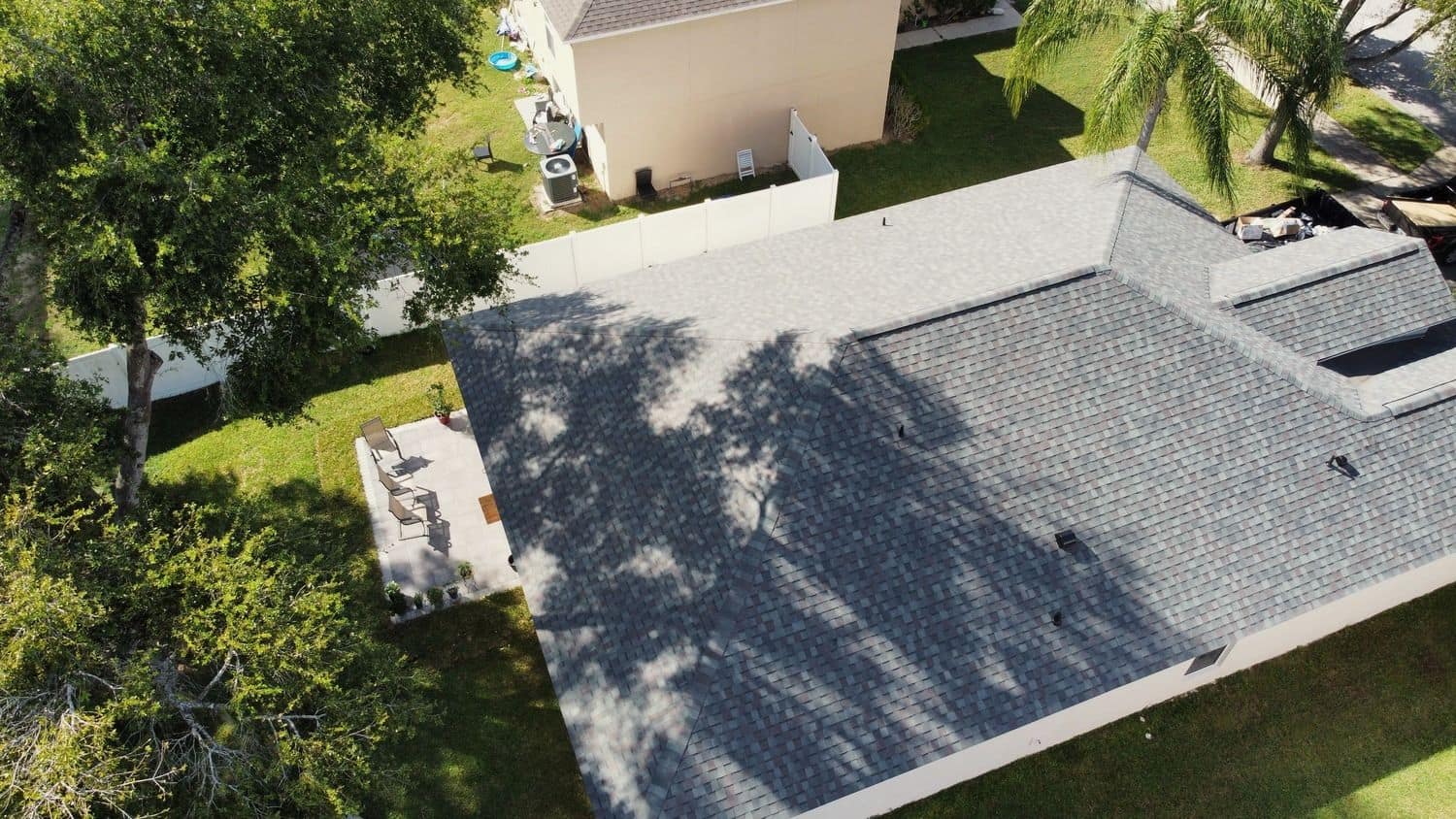
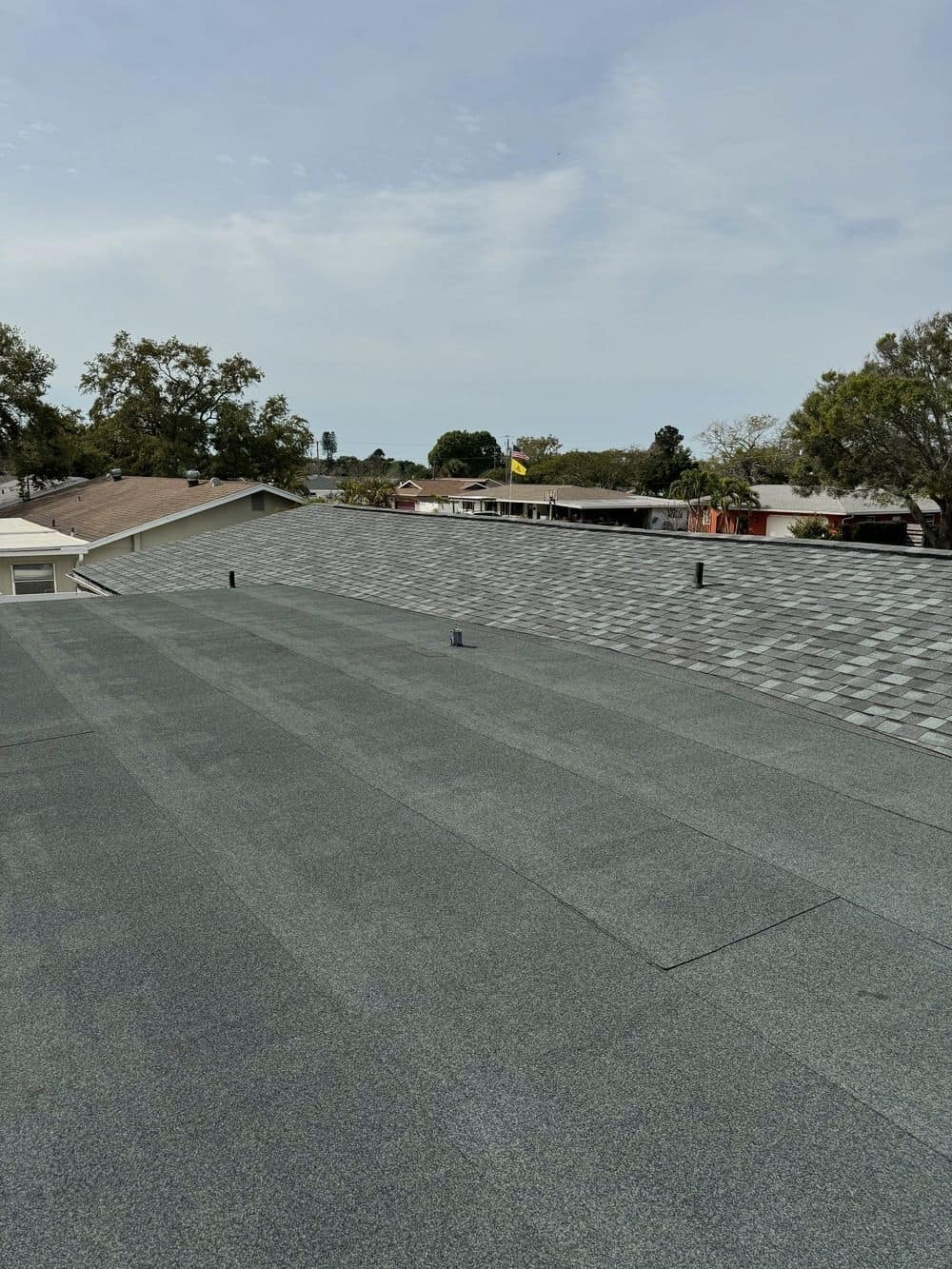
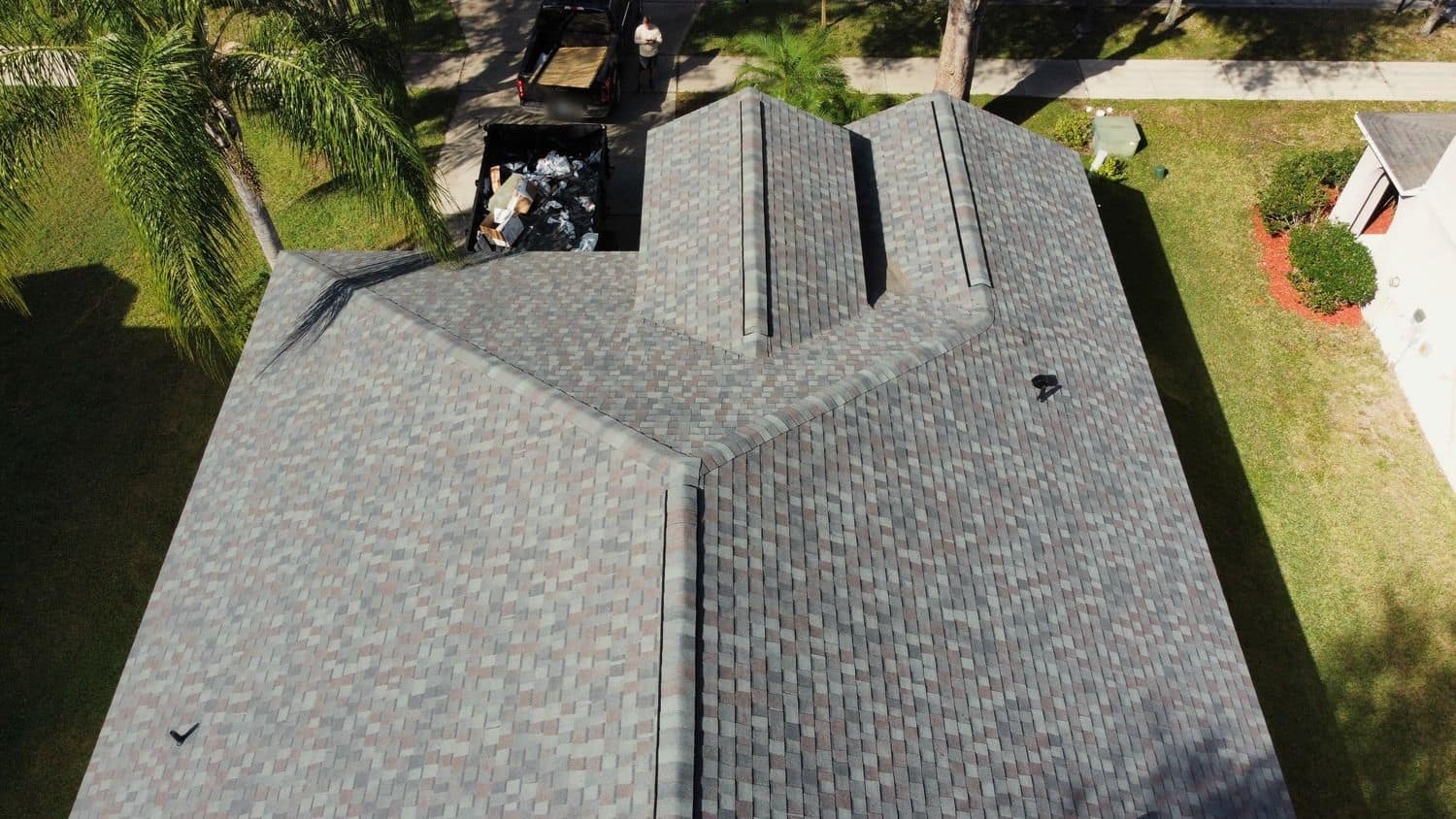
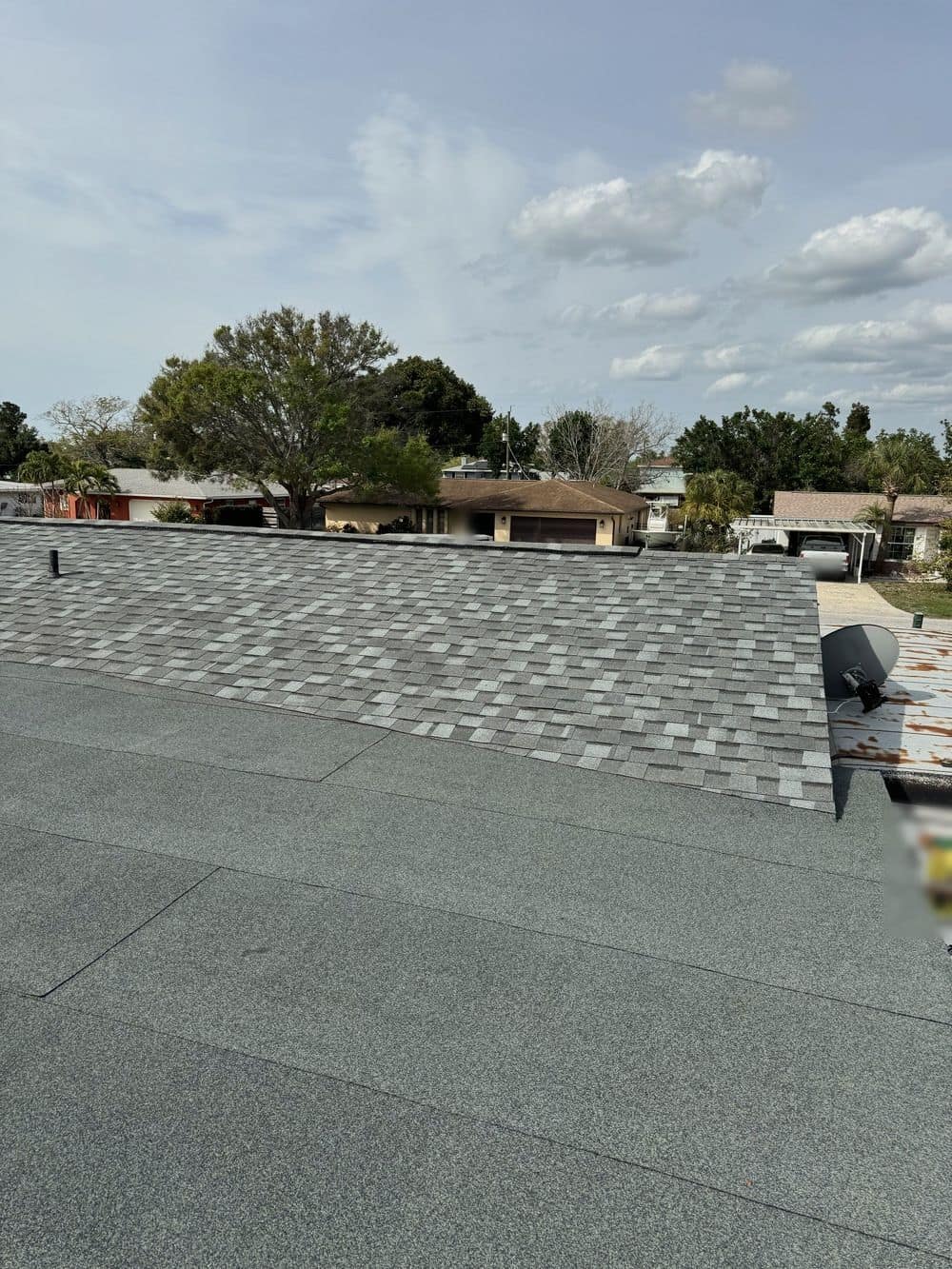
Leaks follow the joints. The code requires flashing where a roof meets a wall, where the slope or direction changes, and around roof openings (R903.2.1). A Florida room roof often has all three. The photos on this page show one such tie-in: a granulated cap sheet carried up to a gray shingle slope.
A flat section can count on its own
Florida's 25% rule caps repairing, replacing or recovering at a quarter of a roof or roof section in any 12 months; past that, the whole section must meet current code (R908.1.1). The code defines a roof section partly by a change in elevation or in roof type, so a membrane porch roof beside a shingle roof can stand as its own section. A roof built, repaired or replaced under the 2007 code or later skips the whole-section step (Fla. Stat. 553.844(5)), as the roof replacement page explains. Your building official decides how the roof divides.
The three membranes
TPO vs EPDM vs modified bitumen on a Florida roof
All three are sheets made to ASTM standards that Florida's residential code names, and each standard describes the sheet, not the finished roof.
Modified bitumen
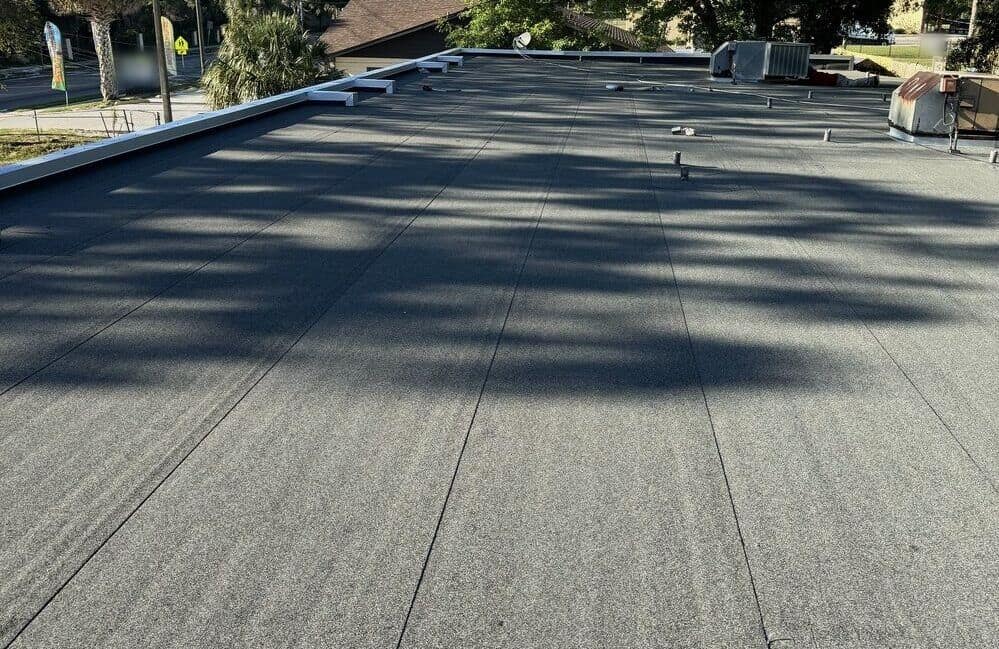
Modified bitumen is asphalt sheet modified with a polymer, either SBS or APP. ASTM's titles for the polyester-reinforced versions of both describe sheets made for multiple-ply membranes, so a mod-bit roof is built in layers. The top layer can be a granulated cap sheet, the gray, gritty surface in the photos on this page.
TPO
TPO, thermoplastic polyolefin, goes down as one sheet. Its standard, ASTM D6878, calls for a weather-exposed sheet with reinforcing fabric or scrim inside.
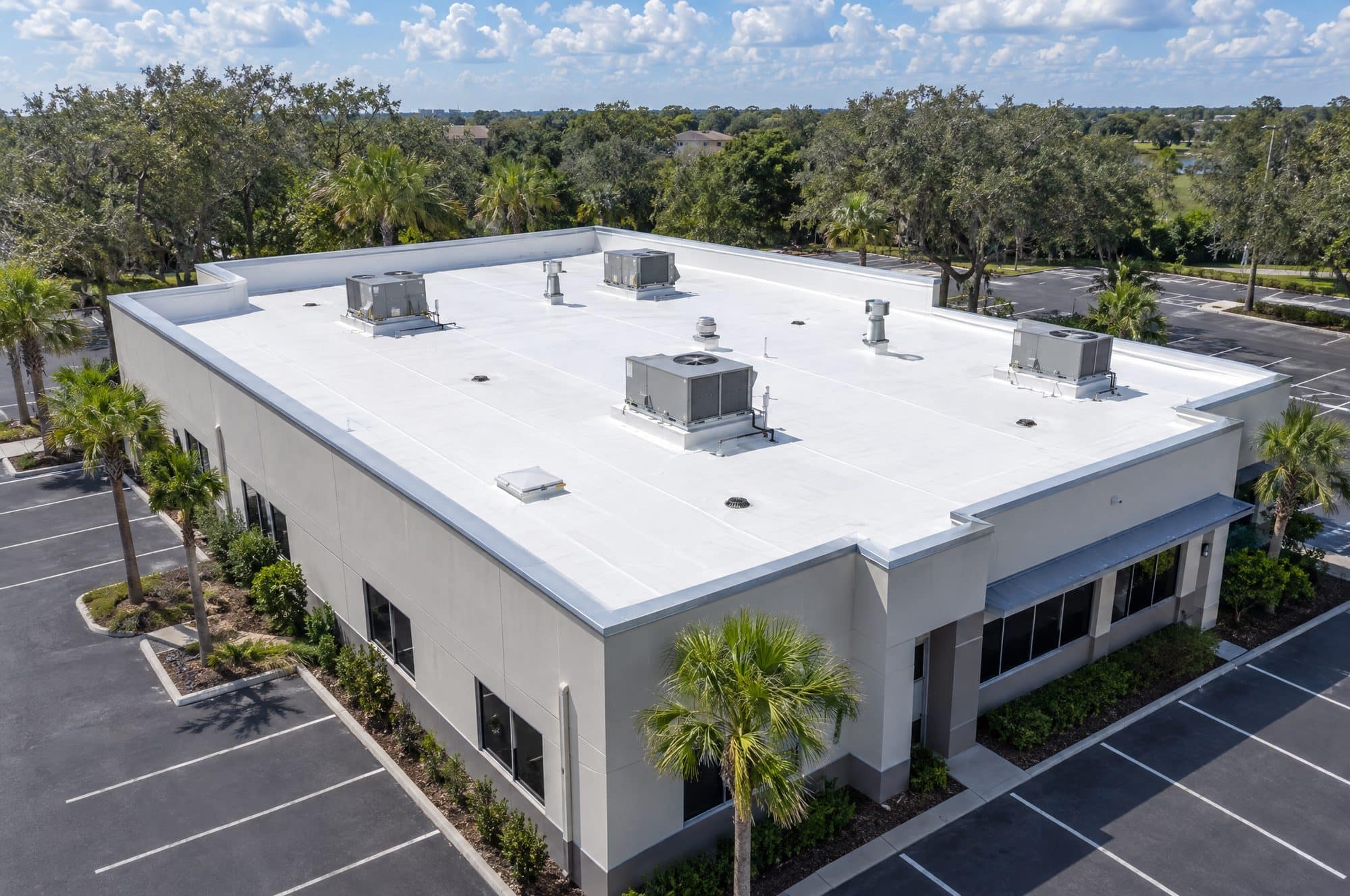
Illustration
Illustration of a white TPO membrane on a commercial roof. Not a South Fork Roofing job.
EPDM
EPDM is a synthetic rubber sheet that ASTM D4637 allows unreinforced, reinforced or fabric-backed. One maker sells its dusted, unreinforced EPDM in 45-mil and 60-mil thicknesses, so a bid should say which one it prices.
Neither the TPO nor the EPDM standard covers fire, seams or wind uplift, so a sheet can pass its test and still be fastened poorly. The residential code fills that gap: a membrane's uplift resistance must meet the design loads in Table R301.2(2).
Which one for a Florida house
We found no neutral source that ranks the three for Florida. Ask instead about plies or sheet thickness, how the seams and wall flashings are made, how light the top surface is, and the FL approval number for the whole system. Standing-seam metal is another code option down to a quarter inch per foot.
South Fork Roofing quotes modified bitumen, TPO and EPDM on porches, Florida rooms, carports, additions and the flat sections of larger homes.
In Florida
What Florida sun, rain and wind do to a flat roof
Start with heat. In the Florida Solar Energy Center's Fort Myers test houses, the attic under dark shingles ran 40°F above the outdoor air at the peak summer hour. Homes with highly reflective roofs stayed no warmer than outdoors. A flat roof faces the midday sun almost head-on, so ask how light its top surface is.
Then rain. NOAA Atlas 14 puts the heaviest 5 minutes of a 10-year storm at 8.71 inches an hour in Orlando and 11.3 at West Palm Beach. For most of West Central Florida, the National Weather Service in Tampa Bay dates the rainy season from May 25 to October 10, with near-daily thunderstorms.
Then wind, from June 1 to November 30, with a peak around September 10, per NOAA's hurricane center. FEMA's Hurricane Michael guidance names wind damage to roof coverings as a primary source of water getting inside. The design wind speed comes from the address, not the county, through the ASCE 7-22 hazard tool the state's wind mitigation form cites.
How long a flat roof lasts in Florida
The sources disagree, and none is strong. NRCA's consumer guidance says most new roofs are designed for about 20 years of service, with climate, design, materials, installation and upkeep setting the real figure. We found no neutral Florida number for each membrane, and the charts that print one show no method, so this page leaves them out.
Ponding
Ponding water: how long is too long
A little water right after a storm is normal on a low-slope roof; the question is how long it stays. We found no primary source that sets a ponding rule for flat roofs on houses, so this page borrows the commercial yardstick.
Florida's Building code sets it at 48 hours: a roof has positive drainage when, with deck sag under load accounted for, it clears within 48 hours of rain. NRCA's membrane manual uses the same mark in drying weather. A 2017 legal note from Florida's roofing and sheet metal contractors' association adds that the typical commercial membrane warranty demands positive drainage or excludes failures caused by its absence.
When water outlasts two dry days, check these first:
Leaves packed into the scupper, drain or gutter at the low edge
A deck that has sagged between the framing, which the code's drainage definition tells designers to allow for
Slope under the quarter inch per foot the code sets for new low-slope roofs
In Broward and Miami-Dade, the code goes further on a reroof. Repairs may not create more ponding, and before work starts the contractor must tell the owner if ponding is possible and recommend a structural review (FBC-Building 1521.3, 1521.13).
Recover or replace
Coat it, recover it or tear it off
Three different jobs get sold as a new flat roof. A coating is liquid spread over the old surface. In the residential code's definitions, a recover puts a new covering over the prepared old one, while a replacement strips the old covering, repairs any damaged deck and installs a new roof (Chapter 2).
When the code calls for a tear-off
On a house, every existing layer must come off first when (R908.3):
The old roof is water-soaked or too deteriorated to serve as a base
The existing roof is slate, wood shingles or shakes, or clay, cement or asbestos-cement tile
The roof already carries two or more coverings
Blisters are present and have not been cut open and secured
The old covering would have to hold the new one down and cannot meet the code's securement rules
The 8th edition marks the residential re-cover sections "Reserved," and we found no statewide answer on whether building departments accept a membrane recover on a house, so ask yours first. The Building volume, which covers commercial buildings, allows a recover when none of its tear-off conditions applies (FBC-Building 1511.3).
What a coating can and cannot do
Under Fla. Stat. 489.105(3)(e), a coating represented to protect, repair, waterproof, stop leaks or extend a roof's life is roofing contractor work. The code names a standard for each coating type, such as acrylic (ASTM D6083) and silicone (D6694). Read the scopes: D6694 covers silicone used as the membrane over spray polyurethane foam, so a pail marked D6694 says nothing about a modified bitumen porch roof.
Two questions come first. Is there wet insulation or decking underneath? A night infrared survey can map it, since wet areas hold heat longer, but core cuts must confirm the readings. Will water pond where the coating goes? One silicone maker markets its coating for ponding areas; no acrylic maker's statement on ponding turned up in our research.
01
Count the layers
Two or more coverings already on the roof rules out a recover.
02
Find the wet areas
Map moisture with a survey, then prove it with core cuts.
03
Wait out a rain
Water still sitting at 48 hours means the drainage gets fixed first.
04
Know the code era
A section built under the 2007 code or later changes what the 25% rule asks.
05
Get the FL number
Look up each product's Florida approval before anything is signed.
Florida code
Permits, inspections and product approval for a low-slope roof
Florida requires a permit to construct, alter or repair a building (FBC-Building 105.1), and re-roofing a porch or Florida room is no exception. Reroofs skip plan review (Section 107), and the building official may let ordinary minor repairs go ahead without a permit (105.2.2).
Two inspections follow: a sheathing inspection of the deck, its fasteners and the dry-in, then a roofing inspection of the dry-in, insulation, coverings and flashing (110.3).
Roofing products need Florida product approval (Fla. Stat. 553.842(5)), and the same law bars selling a product as hurricane or windstorm protection without it. Ask for the FL number of the membrane, its base sheets and any coating, then check each in the Florida Building Commission's product approval search.
Broward and Miami-Dade: the HVHZ
Florida's High-Velocity Hurricane Zone is Broward and Miami-Dade. There, homes follow Chapter 44 of the residential code, reroofing points to Sections 1512 through 1525 of the Building volume, and every roofing job needs a permit, repairs and maintenance included. Loose-laid ballasted membranes are barred, and a new building's roof deck needs at least 1/4:12.
Code citations on this page come from the 8th edition (2023), in force since December 31, 2023; applications filed on or after December 31, 2026 fall under the 9th.
Insurance
Insurance forms and a flat roof: what they say
Only your insurer or agent can say how the forms and statutes below apply to your policy.
On the state wind mitigation form, OIR-B1-1802, "Flat" roof geometry means a building of five or more units with at least 90% of its main roof under 2:12. A single-family home with a flat roof is graded "Other." A roof still grades as hip when its non-hip features add up to no more than 10% of the total roof perimeter, so the edge of a long flat porch roof can matter. Ask whoever signs your form how it was measured.
The same form says standard underlayment and hot-mopped felts do not count as a secondary water barrier. The residential code, for its part, treats a continuous roof system under 2:12 as meeting the re-roof barrier rule (R908.7.2, Exception 1).
Florida's 15-year roof rule makes no exception for flat roofs. An insurer may not refuse to issue or renew a homeowner's policy solely because of the age of a roof under 15 years old. For an older roof, it must allow an inspection by an authorized inspector, at the homeowner's expense, before requiring replacement (Fla. Stat. 627.7011(5)). A 2026 bill to set a separate standard for low-slope roofs of 2-inch pitch or less died in committee on March 13, 2026.
The statute counts a roof's age from the last time 100 percent of its surface was built or replaced (627.7011(5)(d)). When partial jobs add up to the whole roof, the age runs from the first of them. Ask your insurer how a flat section replaced on its own appears in your file.
Citizens Property Insurance asks for proof of at least five years of remaining life on soft roofs, such as shingle, older than 25 years, and on hard roofs older than 50. Its hard list names tile, slate, clay, concrete and metal, not membranes. Citizens' 4-point form also records whether a roof was fully or partly replaced, and what percentage. The roof inspection page covers these forms in full.
Cost
What changes the cost of a flat roof replacement in Florida
We do not publish prices, and one Florida average for flat roofs would hide the things that actually move the number. Compare bids on these, line by line:
The system: modified bitumen ply count, or TPO or EPDM sheet thickness in mil
How many layers come off, since two or more existing coverings means a full tear-off
Wet insulation or decking found by survey and cores, and how much deck gets replaced
Deck attachment the residential code requires whenever a covering is removed and replaced (R908.7)
Flashing where the flat roof meets the walls and the sloped roof above it
Drainage work: added slope, a new scupper or drain, or a gutter at the low edge
Size, height and access, from one small porch to a large addition
In Broward and Miami-Dade, the HVHZ permit and inspection steps
For a store, office, church or condo building, the commercial roofing page covers TPO, EPDM and modified bitumen under the commercial code, from edge-metal tests to condo reserve studies.
Flat roofs: comparison
Item
Modified bitumen
TPO
EPDM
What it is
Asphalt sheet modified with SBS or APP polymer
Thermoplastic polyolefin sheet
Synthetic rubber (thermoset) sheet
How it goes down
In plies; the top can be a granulated cap sheet
One sheet with fabric or scrim inside
One sheet, reinforced or not
Sheet standard
ASTM D6162, D6163, D6164, D6222, D6223, D6298 or D6509
ASTM D6878
ASTM D4637
FBC-Residential section
R905.11
R905.13 (thermoplastic, with PVC)
R905.12 (thermoset)
Minimum design slope
1/4:12
1/4:12
1/4:12
Ask the bid for
Number of plies and the cap sheet
Sheet thickness in mil
Sheet thickness, e.g. 45 or 60 mil
Florida service life
No neutral Florida source found
No neutral Florida source found
No neutral Florida source found
Roof cost estimator
See a ballpark for a flat roof
Answer a few questions about the roof to see a published Florida market range for membrane roofing, spanning TPO, EPDM and modified bitumen. It is labeled as a market figure, not a South Fork Roofing price.
What is the average cost of replacing a flat roof in Florida?
There is no honest single average, and this page prints no prices. A flat roof replacement in Florida is priced from its parts. They include the membrane and its plies or thickness, the old layers that come off, any wet insulation or decking, code-required deck attachment, flashing at the house and drainage fixes. Broward and Miami-Dade add HVHZ permit steps. The quote tool can show a published Florida market range for membrane roofs, labeled as not a South Fork Roofing price.
A modified bitumen roof is built from asphalt sheets modified with a polymer, either SBS (styrene butadiene styrene) or APP (atactic polypropylene). ASTM's titles for the polyester-reinforced versions describe sheets for multiple-ply membranes, which is why mod-bit goes down in layers. The top layer may be a granulated cap sheet that looks like coarse gray sandpaper. Florida's residential code accepts seven ASTM specifications for it and sets its minimum design slope at a quarter inch per foot.
What are the common problems with modified bitumen roofing?
The usual trouble spots are the ones NRCA tells owners to check each fall and spring: loose seams, worn flashings and granules washing into gutters and downspouts. Blisters are another; Florida's residential code will not let new roofing go over them until they are cut open and secured. Water still standing 48 hours after rain is a third. Leaks tend to track the places the code requires flashing, such as the joint where a porch roof meets a wall or runs under a sloped roof.
TPO stands for thermoplastic polyolefin, a single-ply roofing sheet. ASTM D6878 describes a flexible sheet for weather-exposed membranes and requires reinforcing fabric or scrim inside it. Florida's residential code groups TPO with PVC as thermoplastic single-ply and gives it the same quarter-inch-per-foot minimum slope as other membranes. The standard sets a floor for the sheet, not the roof, since fire, seams and uplift depend on the installed assembly. Ask each bid for the sheet thickness in mil and the system's FL approval number.
Which flat roof material is best for a Florida home?
No neutral source we found crowns one membrane for Florida, so be wary of a bid that does. Modified bitumen, TPO and EPDM are all code-listed for roofs with at least a quarter inch of fall per foot. The more useful question is which bid handles your roof's weak spots. Look at drainage within 48 hours, flashing where the roof meets the house, a light top surface, and a ply count or thickness you can compare. Reflective roofs kept Fort Myers test attics no warmer than the outdoor air at the summer peak.
No reliable Florida figure exists for each membrane, and we will not invent one. NRCA's homeowner guidance says most new roofs are designed for about 20 years of useful service, with climate, design, materials, installation and maintenance deciding the rest. One widely copied chart lists Florida figures for TPO, EPDM and modified bitumen that differ from its own national ones, and it shows no method. What you control is drainage, flashing upkeep and a look every fall and spring. Insurer roof-age questions are covered on the roof inspection page.
For a few hours after a storm, yes; for days, no. Florida's Building code defines positive drainage as a roof that clears within 48 hours of rain, and NRCA applies the same test in drying weather. We found no separate ponding rule for houses, so that commercial yardstick is the one to use. Water left after two dry days points to a clogged scupper or gutter at the low edge, a sagging deck, or slope under a quarter inch per foot. Clearing leaves can fix the first; the other two need the deck looked at.
No, but a flat roof leaves less room for error than a sloped one. Florida's code allows them, bars shingles below a 2:12 pitch and metal shingles below 3:12, and sets 1/4:12 as the minimum design slope for most membranes. That small fall must move rain that NOAA Atlas 14 puts at 8.71 to 11.3 inches an hour in a 10-year storm's heaviest 5 minutes, from Orlando to West Palm Beach. So the joints, the drains and the membrane matter more. On the state wind mitigation form, a single-family flat roof grades as Other.
Coat only a roof that is dry underneath and drains; replace one that is not. Florida's residential code requires a tear-off when the old roof is water-soaked or too deteriorated to be a base, or has blisters that were never cut and secured. Find wet insulation or decking with an infrared survey confirmed by core cuts before any coating bid, and check the coating's standard: ASTM D6694 silicone is written for spray foam roofs. A coating sold to stop leaks or extend roof life is roofing contractor work under Fla. Stat. 489.105.
Do I need a permit to replace a Florida room roof?
Yes. Florida's code requires a permit to construct, alter or repair a building, and a new Florida room or porch roof is a re-roof. Reroofs skip plan review but get two inspections, one for the sheathing and dry-in and one for the finished roofing and flashing (FBC-Building 105.1, 107, 110.3). Outside Broward and Miami-Dade, the building official may allow ordinary minor repairs without a permit; inside those HVHZ counties, all roofing work needs one. Start with the building department where the home sits.
Does a flat roof affect home insurance in Florida?
It changes how the roof is described on state forms; only your insurer or agent can say what that means for your policy. On the wind mitigation form, a single-family flat roof grades as Other, because the form's Flat category is for buildings of five or more units. The 15-year roof rule reads the same for flat and sloped roofs, and a 2026 bill giving low-slope roofs their own standard died in committee. Citizens' hard-roof list, with its 50-year age line, names no membranes. Bring the roof's age, permit date and material to your agent.
 Illustration