Commercial roofs · St. Petersburg
Commercial roofing in St. Petersburg, FL
About a third of St. Petersburg's housing, 32%, sits in buildings with five or more units. Those roofs belong to condo associations, landlords and businesses rather than single owners. Commercial roofing in St. Petersburg is about drainage, membranes and the reserve-study law that tells boards when to look.
Updated October 2026
Local know-how
Shared roofs over a third of St. Petersburg's homes
In the Census Bureau's 2020–2024 survey, 32% of the city's 141,508 housing units, roughly 45,000 homes, are in buildings of five or more units. Countywide the share is 30.1%, so St. Petersburg leans slightly more toward shared buildings than Pinellas as a whole.
For condominiums, state law sets the clock. An association must have a structural integrity reserve study at least every 10 years for each building three habitable stories or higher, and the roof is the first item it covers (Fla. Stat. 718.112(2)(g)). The study rests on a visual inspection and gives each item's remaining useful life, which is the number a board budgets against.
Weather tests these roofs hard. Helene sent the St. Petersburg tide gauge to a record 6.31 feet above mean higher high water, and Milton's winds tore away Tropicana Field's fabric roof.
Florida code
Ponding, drains and recover limits on St. Petersburg flat roofs
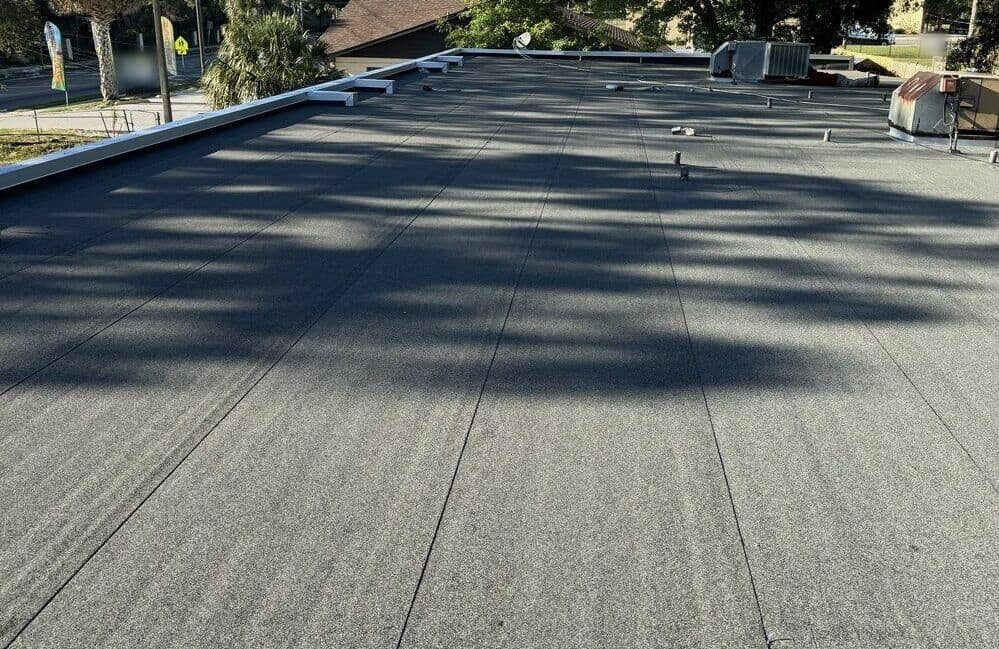
The code defines positive roof drainage as a roof that drains within 48 hours of rain, and NRCA uses the same 48-hour test for ponding. A parapet that would hold water if the main drains clogged needs secondary overflow drains or scuppers as well (FBC-B 1503.4.1).
Drains are sized on the 100-year hourly rainfall rate (FBC-Plumbing 1106.1). At NOAA's Atlas 14 point inside St. Petersburg that rate is 4.05 inches an hour, against 2.84 for a 10-year storm.
Before anyone prices a recover, count the roofs already on the building and look for wet insulation. Two or more existing coverings, or a water-soaked or deteriorated roof, rules out a recover and calls for a tear-off to the deck (2023 FBC-Building, Chapter 15).
Questions
Commercial roofing in St. Petersburg: questions
Does a St. Petersburg condo building need a reserve study for its roof?
If it is three habitable stories or higher, yes. Fla. Stat. 718.112(2)(g) requires a residential condominium association to have a structural integrity reserve study at least every 10 years for each such building, and the roof is the first item on the list. With 32% of St. Petersburg's housing in buildings of five or more units, many associations here fall under it. This is general information; the association's attorney or engineer applies it to a specific building.
How long can water stand on a flat roof in St. Petersburg?
No more than 48 hours after rain, by the code's definition of positive drainage and NRCA's ponding test. That matters here because roughly 62–63% of St. Petersburg's 52.48 inches of normal yearly rain falls from June through September, when storms come close together and a roof has little time to dry. Water that stands longer points to a drainage problem to fix before any coating or patch.
What standards does a TPO or EPDM roof in St. Petersburg have to meet?
The Florida Building Code names them by ASTM standard. TPO sheet meets ASTM D6878, a reinforced thermoplastic polyolefin membrane made for exposed single-ply roofing, and EPDM meets ASTM D4637 (FBC-B Table 1507.12.2). Any low-slope covering must also show it holds up through 2,000 hours of accelerated weathering. Under St. Petersburg sun, with 20.40 inches of Milton rain recorded near the city in one storm, ask for the standard on the product data sheet before you compare bids.
Sources for this page(12)
- 1.Share of homes in buildings with 5+ units: 32%. U.S. Census Bureau, ACS 2024 5-year (2020-2024), table B25024, via Census Reporter API. Read Oct 5, 2026.
- 2.Housing units (ACS 5-year): 141,508. U.S. Census Bureau, ACS 2024 5-year (2020-2024), table B25001, via Census Reporter API. Read Oct 5, 2026.
- 3.Share of homes in buildings with 5+ units: 30.1%. U.S. Census Bureau, ACS 2024 5-year (2020-2024), table B25024, via Census Reporter API. Read Oct 5, 2026.
- 4.NOAA National Hurricane Center, Tropical Cyclone Report: Hurricane Helene. Read Oct 5, 2026.
- 5.NOAA National Hurricane Center, Tropical Cyclone Report: Hurricane Milton. Read Oct 5, 2026.
- 6.NOAA NCEI U.S. Climate Normals 1991-2020, stations USC00087886 ST PETERSBURG and USW00012873 ST PETERSBURG INTL AP. Read Oct 5, 2026.
- 7.Florida Statutes, section 718.112 (2026). Read Oct 5, 2026.
- 8.2023 Florida Building Code, Building, 8th ed., Chapter 15 (UpCodes viewer, unofficial transcription). Read Oct 5, 2026. FBC text read from UpCodes (unofficial transcription): check floridabuilding.org or the ICC viewer before quoting (spec 8.7). Source URL inherited from C-14 (the research cites it "as C-14").
- 9.Florida Roofing and Sheet Metal Contractors Association (FRSA). Read Oct 5, 2026.
- 10.2023 Florida Building Code, Plumbing, 8th ed., Chapter 11 (UpCodes viewer, unofficial transcription). Read Oct 5, 2026. FBC text read from UpCodes (unofficial transcription): check floridabuilding.org or the ICC viewer before quoting (spec 8.7).
- 11.ASTM International. Read Oct 5, 2026.
- 12.NOAA Atlas 14 Volume 9, version 2, point precipitation frequency estimates (partial-duration series) at St. Petersburg, NOAA National Weather Service, Hydrometeorological Design Studies Center. Read Oct 5, 2026. Point: the 2020 TIGER internal point of the city (TIGERweb 2020 incorporated place internal point (INTPTLAT/INTPTLON)).
South Fork Roofing
Commercial roofing in St. Petersburg
Answer a few questions about the job, or call.