Gutters · University
Gutters in University, FL
A 5-minute downpour in a 10-year storm falls at 8.81 inches an hour in University. That is the rate your gutters and downspouts have to move off the roof without overflowing. Most of the year is quieter, but the summer storms set the sizing. Knowing the local numbers helps you judge whether your current gutters can keep up.
Updated October 2026
University figures this page uses
- Housing units (ACS 5-year)
- 10,271
- Owner-occupied share of occupied homes
- 37.4%
- Median year homes were built
- 1994
Local rainfall
How much water does a roof in University have to shed?
A 1-hour rain in a 10-year storm comes down at 2.94 inches an hour here. A 24-hour storm of that size drops 6.37 inches. In a 100-year storm the same 24 hours brings 10.9 inches. Orlando's normal rainfall is about 51 inches a year, and roughly 45 percent of it falls June through August. Gutters that look fine in a dry month can overflow in a single afternoon storm.
 Illustration
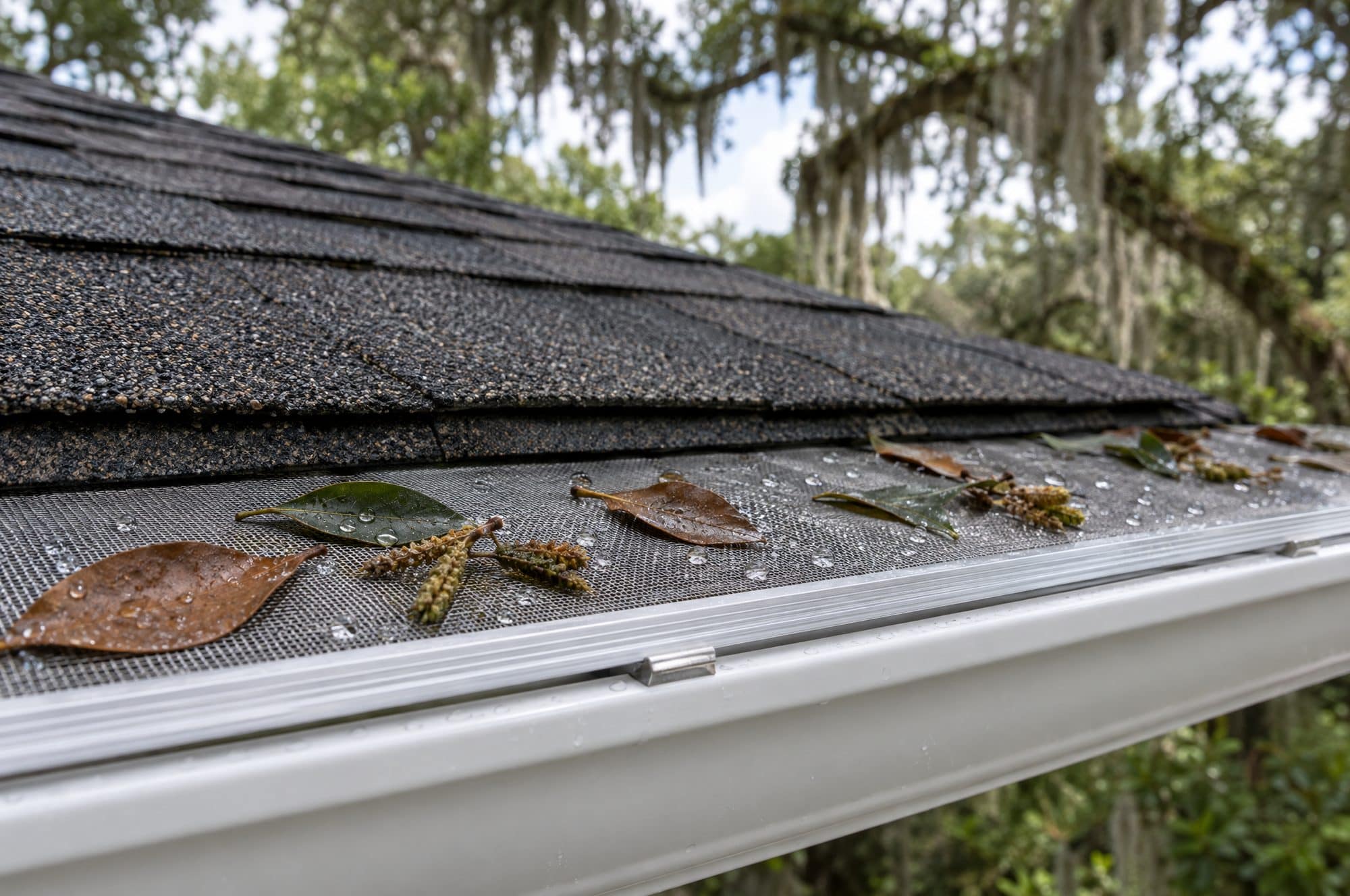
Illustration: micro mesh guard
Gutter capacity is set by the design rainfall rate, not by how the house looks. The plumbing code sizes horizontal gutters from the roof surface flow, and the same code sets leader capacity by pipe size. In University, a 6-inch half-round gutter at 1/8 inch per foot slope carries 110 gallons per minute. By our arithmetic, that is about 49 percent more than a 5-inch half-round at the same slope.
Code and discharge
Downspouts and where the water has to go
On a home in University, a downspout that empties beside the foundation can push water toward the slab. The residential code requires downspouts to discharge at least 1 foot from the sidewall, by underground pipe, tail extension or splash block. Gutters are required on most one-story homes with eaves under 6 inches, except at gable rakes or where one roof sits above another.
Downspout sizing matters as much as gutter sizing. A 2 1/2 by 3 inch leader handles 92 gallons per minute, while a 3 by 4 1/4 inch or 4 inch round leader handles 192. Add half the area of any vertical wall that sheds rain onto the roof, as the code directs.
Keep gutters clear
Leaves, pollen and cleaning on tree-lined lots
Live oaks drop leaves and fruit that become a litter problem in gutters. Oaks and pines are major pollen producers here, and the Florida pollen season runs January through June with peaks in March and April. Pine needles fall heaviest September through November. Consumer testing found fine-mesh guards outperformed larger-hole screens, but a severe downpour still overwhelmed the top-scoring one.
Clean gutters at least twice a year, and more often under heavy canopy. A workable rhythm is after the spring oak drop, before June, and after the autumn pine-needle peak. Clogged gutters can cause water damage and foundation problems, so confirm your schedule with your roofer.
Rain on your roof
Preset: 6.37 inches, the 10-year 24-hour rain (NOAA Atlas 14 at University).
7,937 gallons run off that roof, all of it toward the gutters and downspouts.
Math: square feet × inches × 0.623 gallons.
Questions
Gutters in University: questions
How big should gutters be for rain in University?
Size them for the 5-minute, 10-year rate of 8.81 inches an hour, not the average. The plumbing code gives gutter capacities by size and slope. At a 1/8 inch per foot slope, a 6-inch half-round moves 110 gallons per minute, roughly 49 percent more than a 5-inch unit set at that same pitch. Ask your roofer to check your current gutters against those tables before a storm season.
Source: NOAA Atlas 14 Volume 9 version 2, partial-duration intensity estimates at the University 2020 Census internal point (28.5890, -81.1975), read Oct 5, 2026
Where should my downspouts send the water?
The residential code requires downspouts to discharge at least 1 foot from the structure sidewall in University. Underground piping, tail extensions or splash blocks can meet that rule. If water runs back toward the foundation, the discharge is too close. Orange County's Division of Building Safety issues the permits for this work, so check with them if you are unsure what your home needs.
Source: 2023 Florida Building Code, Residential, 8th ed., R318.5 (UpCodes viewer, unofficial transcription); FBC-Building 1503.7, read Oct 5, 2026
How often should I clean gutters with oaks nearby?
Plan on cleaning them two times a year as a minimum, and step that up when trees overhang the house heavily. In University, about 37.4 percent of occupied homes are owner-occupied, and many of the 10,271 housing units sit near oaks. Live oaks shed leaves and fruit that become a litter problem. Oaks and pines peak in pollen March and April, and pine needles fall heaviest September through November. Schedule a cleaning after the spring oak drop and before the June storm season.
Source: U.S. Census Bureau, American Community Survey 2020-2024 5-year estimates (acs2024_5yr), via Census Reporter API, read Oct 5, 2026
Do gutter guards stop all the debris?
No. In University, where 10,271 housing units and the median home dates to 1994, consumer testing found fine-mesh screens did better than screens with larger holes. Even the top-scoring screen was only middling at handling a severe downpour. Inserts performed poorly, and guards still need brushing in high-pollen areas. Plan on some cleaning even with guards installed.
Source: U.S. Census Bureau, American Community Survey 2020-2024 5-year estimates (acs2024_5yr), via Census Reporter API, table B25035, read Oct 5, 2026
Sources for this page(33)
- 1.NOAA NCEI, U.S. Climate Normals 1991-2020 (annual/seasonal), access-data API. Read Oct 5, 2026.
- 2.Permit office: Orange County Division of Building Safety. Orange County Division of Building Safety. Read Oct 10, 2026.
- 3.Housing units (ACS 5-year): 10,271. U.S. Census Bureau, American Community Survey 2020-2024 5-year estimates (acs2024_5yr), via Census Reporter API. Read Oct 5, 2026.
- 4.Owner-occupied share of occupied homes: 37.4%. U.S. Census Bureau, American Community Survey 2020-2024 5-year estimates (acs2024_5yr), via Census Reporter API. Read Oct 5, 2026.
- 5.Median year homes were built: 1994. U.S. Census Bureau, American Community Survey 2020-2024 5-year estimates (acs2024_5yr), via Census Reporter API. Read Oct 5, 2026.
- 6.U.S. Census Bureau, American Community Survey 2020-2024 5-year estimates (acs2024_5yr), via Census Reporter API, table B25035. Read Oct 5, 2026.
- 7.NOAA Atlas 14 (HDSC Precipitation Frequency Data Server). Read Oct 5, 2026.
- 8.2023 Florida Building Code, Plumbing, 8th ed., Chapter 11 (UpCodes viewer, unofficial transcription). Read Oct 5, 2026. FBC text read from UpCodes (unofficial transcription): check floridabuilding.org or the ICC viewer before quoting (spec 8.7). Source URL inherited from COM-20 (the research cites it "as COM-20").
- 9.2023 Florida Building Code, Residential, 8th ed., R318.5 (UpCodes viewer, unofficial transcription); FBC-Building 1503.7. Read Oct 5, 2026. FBC text read from UpCodes (unofficial transcription): check floridabuilding.org or the ICC viewer before quoting (spec 8.7).
- 10.2023 Florida Building Code, Residential, 8th ed., Chapter 3 (UpCodes viewer, unofficial transcription). Read Oct 5, 2026. FBC text read from UpCodes (unofficial transcription): check floridabuilding.org or the ICC viewer before quoting (spec 8.7).
- 11.2023 Florida Building Code, Residential, 8th ed., Chapter 8 (UpCodes viewer, unofficial transcription). Read Oct 5, 2026. FBC text read from UpCodes (unofficial transcription): check floridabuilding.org or the ICC viewer before quoting (spec 8.7). Source URL inherited from NC-2 (the research cites it "as NC-2").
- 12.ask.ifas.ufl.edu. Read Oct 5, 2026.
- 13.blogs.ifas.ufl.edu. Read Oct 5, 2026.
- 14.ufdcimages.uflib.ufl.edu. Read Oct 5, 2026.
- 15.consumerreports.org. Read Oct 5, 2026.
- 16.thig.com. Read Oct 5, 2026.
- 17.NOAA Atlas 14 Volume 9 version 2, partial-duration intensity estimates at the University 2020 Census internal point (28.5890, -81.1975), NOAA Hydrometeorological Design Studies Center. Read Oct 5, 2026.
- 18.NOAA Atlas 14 Volume 9 version 2, partial-duration 24-hour depth estimates at the University 2020 Census internal point (28.5890, -81.1975), NOAA Hydrometeorological Design Studies Center. Read Oct 5, 2026.
- 19.Orange County Division of Building Safety, ocfl.net. Read Oct 5, 2026.
- 20.U.S. Census Bureau, American Community Survey 2020-2024 5-year estimates (acs2024_5yr), via Census Reporter API, table B25024, U.S. Census Bureau (via Census Reporter). Read Oct 5, 2026.
- 21.U.S. Census Bureau, American Community Survey 2020-2024 5-year estimates (acs2024_5yr), via Census Reporter API, table B25024, U.S. Census Bureau (via Census Reporter). Read Oct 5, 2026.
- 22.Florida Statutes, section 627.7011 (2026), Florida Legislature. Read Oct 4, 2026.
- 23.Orange County Government, Division of Building Safety, ocfl.net. Read Oct 5, 2026.
- 24.2023 Florida Building Code, Building, 8th ed., Chapter 15 (UpCodes viewer, unofficial transcription), UpCodes (Florida Building Code transcription). Read Oct 5, 2026.
- 25.Florida Statutes, section 713.135 (2026), Florida Legislature. Read Oct 5, 2026.
- 26.2023 Florida Building Code, Building, 8th ed., Chapter 1 (UpCodes viewer, unofficial transcription), UpCodes (Florida Building Code transcription). Read Oct 5, 2026.
- 27.FRSA, "New 2023 FBC Eighth Edition is Now in Effect", 2024-02-13, floridaroof.com. Read Oct 5, 2026.
- 28.Miami-Dade County RER notice, Miami. Read Oct 5, 2026.
- 29.NWS Melbourne, Post Tropical Cyclone Report: Hurricane Matthew (2016), National Weather Service. Read Oct 5, 2026.
- 30.NWS Melbourne, Post Tropical Cyclone Report: Hurricane Irma (2017), National Weather Service. Read Oct 5, 2026.
- 31.NWS Melbourne, Lightning Information Center, National Weather Service. Read Oct 5, 2026.
- 32.NWS Melbourne, Post Tropical Cyclone Report: Hurricane Ian (2022), National Weather Service. Read Oct 5, 2026.
- 33.NOAA Atlas 14 at University: 8.81 in/hr (5-minute, 10-year). NOAA Atlas 14 Precipitation Frequency Data Server. Read Oct 5, 2026.
South Fork Roofing
Gutters in University
Answer a few questions about the job, or call.