Gutters · Port St. John
Gutters in Port St. John, FL
A 5-minute downpour in a 10-year storm falls at 9.86 inches an hour in Port St. John. Gutters and downspouts that handle ordinary rain can overflow fast in that kind of burst. Sizing and downspout placement decide whether the water leaves your lot or runs along your foundation.
Updated October 2026
Rainfall and sizing
Gutter capacity needed to handle rainfall in Port St. John
Local rainfall is measured in short bursts, not just daily totals. A 1-hour rain in a 10-year storm falls at 3.01 inches an hour here. A 24-hour storm in that same 10-year class drops 7.28 inches. Those figures set the load your gutters carry.
 Illustration
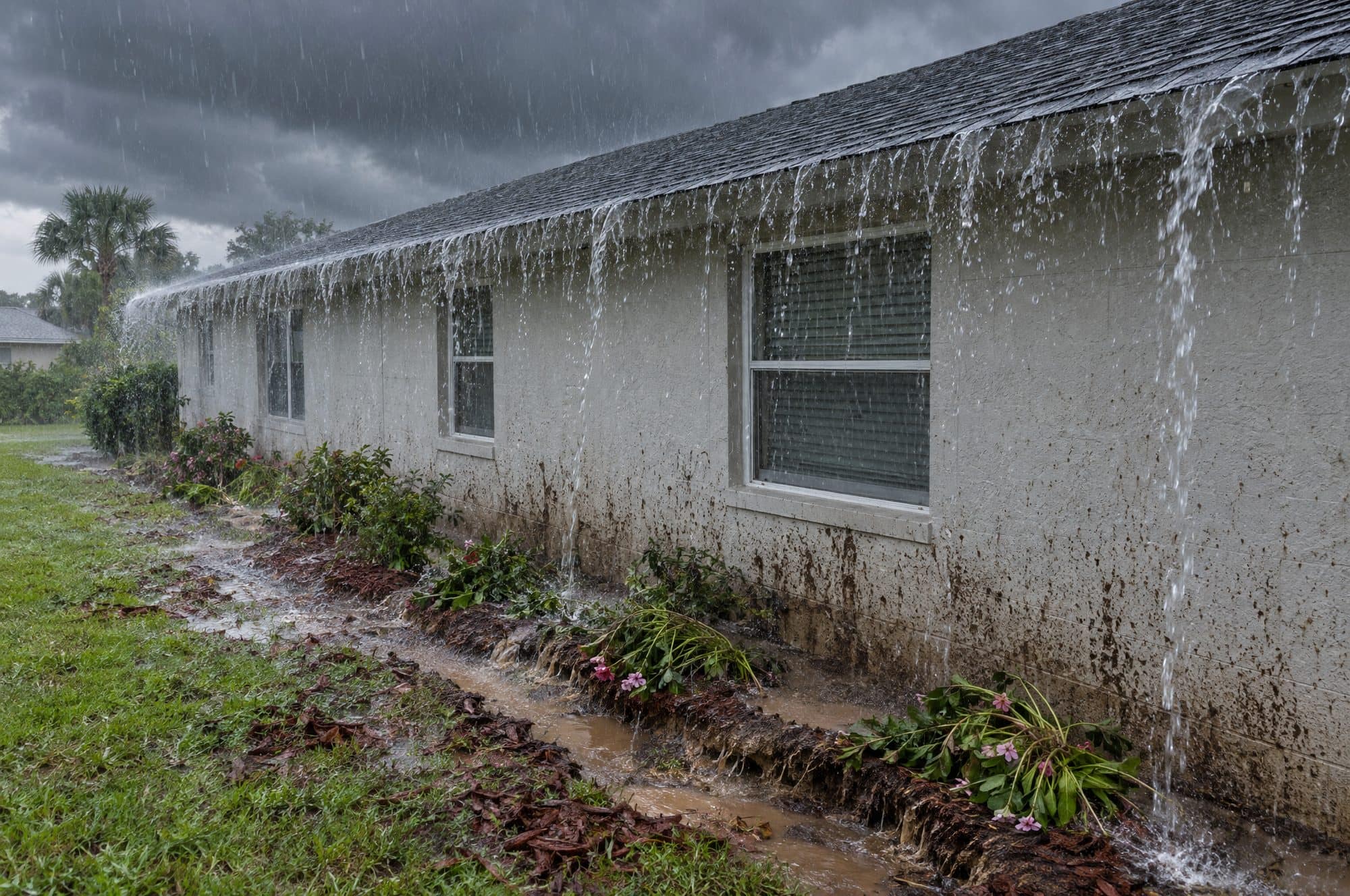
Illustration: downpour no gutter
Gutter widths for horizontal runs are determined by the roof's water flow, as set by plumbing code. A 6-inch half-round gutter at 1/8 inch per foot slope carries about 110 gallons per minute, while a 5-inch size carries 74. Moving up one size gives you about 49 percent more capacity.
Sizing also depends on which rain intensity the designer uses. The same 6-inch gutter serves far less roof area on a short, intense burst than on a longer, gentler storm. Ask whoever sizes your system which storm basis they used.
Code and discharge
Downspout code and where the water should go
Florida code requires downspouts to discharge at least 1 foot away from the structure sidewall, by underground piping, tail extensions or splash blocks. On many Port St. John lots built around the median 1989 year, that means checking the discharge point before the next storm.
- Keep every downspout outlet at least a foot away from the wall of the structure.
- Gutters are required on buildings whose eaves project less than 6 inches.
- Leaders are sized by downspout area, such as 2 by 3 inches or 3 by 4 inches.
Debris and cleaning
Leaves, oaks and pine needles in Port St. John
Southern live oaks are semi-evergreen and drop litter, and they can grow 60 to 80 feet tall. Oak and pine pollen typically reaches its highest levels during March and April. Clogged gutters from that debris are a common cause of overflow here.
Florida's storm season runs June through September, so clean before it starts. Experts suggest at least twice a year, and more often under heavy canopy.
Rain on your roof
Preset: 7.28 inches, the 10-year 24-hour rain (NOAA Atlas 14 at Port St. John).
9,071 gallons run off that roof, all of it toward the gutters and downspouts.
Math: square feet × inches × 0.623 gallons.
Questions
Gutters in Port St. John: questions
How hard does it rain in Port St. John?
A 5-minute downpour in a 10-year storm falls at 9.86 inches an hour in Port St. John. A 100-year 5-minute burst reaches 13.8 inches an hour. A 24-hour 10-year storm drops 7.28 inches. The figures used here come from NOAA Atlas 14 for this town. Gutter capacity has to handle bursts like these, not just average rain. Confirm your local design basis with a licensed contractor.
Source: NOAA Atlas 14 Volume 9 version 2, partial-duration intensity estimates at the Port St. John 2020 Census internal point (28.4757, -80.8104), read Oct 5, 2026
Where should my downspouts drain in Port St. John?
Under Florida code, a downspout outlet has to sit at least one foot out from the sidewall of the building. You can meet that requirement with buried pipe, extended tails, or splash blocks. Port St. John's housing stock is fairly established, with a median build year of 1989, so many older gutter systems here may have outlets that have settled or shifted over time. Check the discharge point after a heavy rain. Water pooling against the foundation is a sign the discharge needs changing.
Source: 2023 Florida Building Code, Residential, 8th ed., Chapter 8 (UpCodes viewer, unofficial transcription), read Oct 5, 2026
How often should I clean gutters near oaks in Port St. John?
Clean them at least twice a year, typically spring and fall, and more often under heavy oak or pine cover. Expect falling debris from live oaks, with pollen reaching its highest levels in March and April. Clean before the June through September storm season begins. Many Port St. John homes date to around 1989, when gutter systems were already common, so older runs often have sagging sections that trap debris. Insurers and gutter testers both note that clogged gutters can cause water damage and foundation problems.
Source: thig.com, read Oct 5, 2026
Do new Port St. John homes need gutters?
Buildings with eaves projecting under 6 inches need gutters and downspouts under Florida code, though gable end rakes and roofs sitting over another roof are exempt. Only 1.9 percent of Port St. John homes were built in 2010 or later, so most homes here are older. Confirm your eave width and any exceptions with the Brevard County building office.
Source: 2023 Florida Building Code, Residential, 8th ed., Chapter 3 (UpCodes viewer, unofficial transcription), read Oct 5, 2026
Sources for this page(27)
- 1.Median year homes were built: 1989. U.S. Census Bureau, American Community Survey 2020-2024 5-year estimates (acs2024_5yr), via Census Reporter API. Read Oct 5, 2026.
- 2.U.S. Census Bureau, American Community Survey 2020-2024 5-year estimates (acs2024_5yr), via Census Reporter API, table B25035. Read Oct 5, 2026.
- 3.Hurricane Irma (2017). NWS Melbourne, Post Tropical Cyclone Report: Hurricane Irma (2017). Read Oct 5, 2026.
- 4.U.S. Census Bureau, American Community Survey 2020-2024 5-year estimates (acs2024_5yr), via Census Reporter API, table B25034. Read Oct 5, 2026.
- 5.Permit office: Brevard County Planning & Development, Building Permits. Brevard County Planning & Development, Building Permits. Read Oct 10, 2026.
- 6.2023 Florida Building Code, Plumbing, 8th ed., Chapter 11 (UpCodes viewer, unofficial transcription). Read Oct 5, 2026. FBC text read from UpCodes (unofficial transcription): check floridabuilding.org or the ICC viewer before quoting (spec 8.7). Source URL inherited from COM-20 (the research cites it "as COM-20").
- 7.NOAA Atlas 14 (HDSC Precipitation Frequency Data Server). Read Oct 5, 2026.
- 8.2023 Florida Building Code, Residential, 8th ed., Chapter 8 (UpCodes viewer, unofficial transcription). Read Oct 5, 2026. FBC text read from UpCodes (unofficial transcription): check floridabuilding.org or the ICC viewer before quoting (spec 8.7). Source URL inherited from NC-2 (the research cites it "as NC-2").
- 9.2023 Florida Building Code, Residential, 8th ed., R318.5 (UpCodes viewer, unofficial transcription); FBC-Building 1503.7. Read Oct 5, 2026. FBC text read from UpCodes (unofficial transcription): check floridabuilding.org or the ICC viewer before quoting (spec 8.7).
- 10.ask.ifas.ufl.edu. Read Oct 5, 2026.
- 11.blogs.ifas.ufl.edu. Read Oct 5, 2026.
- 12.thig.com. Read Oct 5, 2026.
- 13.2023 Florida Building Code, Residential, 8th ed., Chapter 3 (UpCodes viewer, unofficial transcription). Read Oct 5, 2026. FBC text read from UpCodes (unofficial transcription): check floridabuilding.org or the ICC viewer before quoting (spec 8.7).
- 14.NOAA Atlas 14 Volume 9 version 2, partial-duration intensity estimates at the Port St. John 2020 Census internal point (28.4757, -80.8104), NOAA Hydrometeorological Design Studies Center. Read Oct 5, 2026.
- 15.NOAA Atlas 14 Volume 9 version 2, partial-duration 24-hour depth estimates at the Port St. John 2020 Census internal point (28.4757, -80.8104), NOAA Hydrometeorological Design Studies Center. Read Oct 5, 2026.
- 16.NWS Melbourne, Post Tropical Cyclone Report: Hurricane Irma (2017), National Weather Service. Read Oct 5, 2026.
- 17.Brevard County Planning & Development, Building Permits, Brevard County Planning & Development. Read Oct 5, 2026.
- 18.U.S. Census Bureau, American Community Survey 2020-2024 5-year estimates (acs2024_5yr), via Census Reporter API, table B25024, U.S. Census Bureau (via Census Reporter). Read Oct 5, 2026.
- 19.Brevard County, Building Code Wind Speed Maps, Brevard County. Read Oct 5, 2026.
- 20.2023 Florida Building Code, Building, 8th ed., Chapter 1 (UpCodes viewer, unofficial transcription), UpCodes (Florida Building Code transcription). Read Oct 5, 2026.
- 21.2023 Florida Building Code, Building, 8th ed., Chapter 15 (UpCodes viewer, unofficial transcription), UpCodes (Florida Building Code transcription). Read Oct 5, 2026.
- 22.Citizens Property Insurance Corporation, inspections FAQ (updated 2026-03-17), Citizens Property Insurance. Read Oct 4, 2026.
- 23.Florida Statutes, section 489.113 (2026), Florida Legislature. Read Oct 5, 2026.
- 24.Florida Statutes, section 713.135 (2026), Florida Legislature. Read Oct 5, 2026.
- 25.NWS Melbourne, Post Tropical Cyclone Report: Hurricane Matthew (2016), National Weather Service. Read Oct 5, 2026.
- 26.NOAA NCEI, U.S. Climate Normals 1991-2020 (annual/seasonal), access-data API, NOAA National Centers for Environmental Information. Read Oct 5, 2026.
- 27.NOAA Atlas 14 at Port St. John: 9.86 in/hr (5-minute, 10-year). NOAA Atlas 14 Precipitation Frequency Data Server. Read Oct 5, 2026.
South Fork Roofing
Gutters in Port St. John
Answer a few questions about the job, or call.