Gutters · Opa-locka
Gutters in Opa-locka, FL
A 10-year storm in Opa-locka drops rain at 10.9 inches an hour during its worst five minutes. That peak, not the daily total, decides whether a gutter overflows at a home built around 1969. Gutter size, downspout discharge and leaf cleaning all follow from that number.
Updated October 2026

 Our work
Sizing for the burst
How big a gutter does Opa-locka rain require?
The city's design rain is steep. A 1-hour rain in a 10-year storm falls at 3.4 inches an hour, and a 100-year storm reaches 5.29 inches an hour over the same hour. Those are the figures a gutter has to survive. The 24-hour total in a 10-year storm is 8.46 inches, so most of the water arrives in short, intense bursts rather than steady rain.
 Illustration
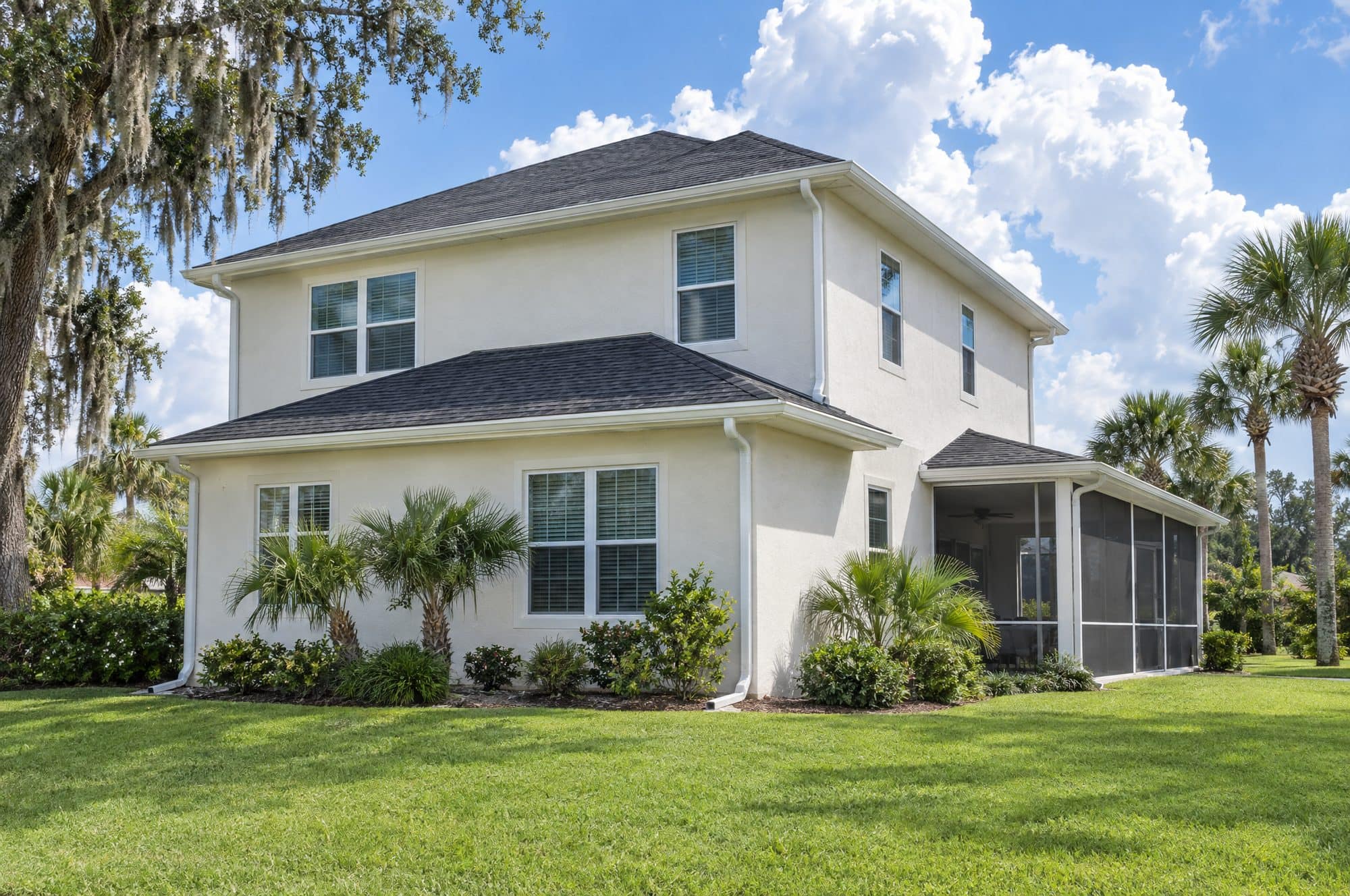
Illustration: two story system
The plumbing code sizes horizontal gutters from the roof's flow rate, and it lists capacities by gutter size and slope. By our arithmetic, a 6-inch half-round gutter at 1/8 inch per foot carries 110 gallons per minute, about 49 percent more than a 5-inch gutter at the same slope. For many Opa-locka roofs, stepping up one gutter size is the cheapest way to add margin.
- Measure the roof's plan area and any pitch above 3 inches per foot.
- Count any wall above the roof that drains onto it, at half its area.
- Check the gutter size against the table, using the 5-minute burst basis.
Code and discharge
Where Opa-locka downspouts must discharge
Homes with eaves that project less than 6 inches need gutters with downspouts, except at gable end rakes or where a roof sits above another roof. The downspout must discharge at least 1 foot from the sidewall. That distance keeps the water from soaking the foundation under a house built in 1969 or earlier, when many slabs and footings were built without modern drainage in mind.
Median homes here were built in 1969, and 64.6 percent of units predate 1980. Many of those homes likely still have original gutters that were never resized, so an older system may carry less water than a storm now demands.
Keeping the flow open
Leaves, trees and cleaning in Opa-locka
Southern live oaks drop leaves and fruit that litter a roof and clog a gutter. The trees can reach 60 to 80 feet tall with a 60 to 120 foot spread, so a single mature oak can drop debris across much of a lot. Oaks and pines are major pollen producers, and the Florida pollen season runs January to June, peaking in March and April.
Gutter cleaning should follow the trees. Plan one clearing after the spring oak drop in late April and May, another before the June to September storm season, and a third after the autumn pine-needle peak in late November and December. An insurer's guidance says to clean at least twice a year and more often with overhanging trees. A gutter left full of debris during a 10.9 inch an hour burst cannot move the water it was sized to carry. At Miami International Airport, 76.6 percent of the year's rain falls from May to October, so the clearing before June matters most.
Rain on your roof
Preset: 8.46 inches, the 10-year 24-hour rain (NOAA Atlas 14 at Opa-locka).
10,541 gallons run off that roof, all of it toward the gutters and downspouts.
Math: square feet × inches × 0.623 gallons.
Questions
Gutters in Opa-locka: questions
How much rain can a gutter in Opa-locka actually handle?
The design figure to use is the 5-minute burst. In a 10-year storm, rain in Opa-locka can fall at 10.9 inches an hour. A gutter should be sized for that peak, not the daily total. The plumbing code gives capacity tables by gutter size and slope, so the building office or a contractor can check your roof's flow rate against them. Confirm the numbers with the City of Opa-locka building office before you buy.
Source: NOAA Atlas 14 Volume 9 version 2, partial-duration intensity estimates at the Opa-locka 2020 Census internal point (25.9000, -80.2552), read Oct 5, 2026
Where should a downspout drain in Opa-locka?
The residential code requires downspouts to discharge at least 1 foot from the structure sidewall. Underground piping, a tail extension and a splash block all meet the rule. The point is to keep rain away from the foundation. Many homes here were built around 1969, and an older foundation benefits from that clearance.
Source: 2023 Florida Building Code, Residential, 8th ed., Chapter 8 (UpCodes viewer, unofficial transcription), read Oct 5, 2026
Do I need gutters on my Opa-locka home?
The code requires gutters with downspouts on homes whose eaves project less than 6 inches, except at gable end rakes or where a roof sits above another roof. Measure your eave projection: if it is under 6 inches, the rule applies. The City of Opa-locka building office, which handles permits for the city's 16,463 residents, can confirm how it applies to your house.
Source: 2023 Florida Building Code, Residential, 8th ed., Chapter 3 (UpCodes viewer, unofficial transcription), read Oct 5, 2026
How often should I clean gutters under oaks in Opa-locka?
Plan three cleanings: after the spring oak drop in late April and May, before the June to September storm season, and after the autumn pine-needle peak in late November and December. Under heavy canopy you may need more. An insurer advises cleaning at least twice a year. Miami International Airport records 76.6 percent of its annual rain from May to October, so the pre-June clearing carries the most weight.
Source: ask.ifas.ufl.edu, read Oct 5, 2026
Sources for this page(26)
- 1.Median year homes were built: 1969. U.S. Census Bureau, American Community Survey 2024 5-year estimates (2020-2024), table B25035, via Census Reporter API. Read Oct 5, 2026.
- 2.U.S. Census Bureau, American Community Survey 2024 5-year estimates (2020-2024), table B25035, via Census Reporter API. Read Oct 5, 2026.
- 3.U.S. Census Bureau, American Community Survey 2024 5-year estimates (2020-2024), table B25034, via Census Reporter API. Read Oct 5, 2026.
- 4.NOAA NCEI U.S. Climate Normals 1991-2020 (access data service). Read Oct 5, 2026.
- 5.Permit office: City of Opa-locka - Building & Licenses. City of Opa-locka - Building & Licenses. Read Oct 10, 2026.
- 6.2023 Florida Building Code, Residential, 8th ed., R318.5 (UpCodes viewer, unofficial transcription); FBC-Building 1503.7. Read Oct 5, 2026. FBC text read from UpCodes (unofficial transcription): check floridabuilding.org or the ICC viewer before quoting (spec 8.7).
- 7.2023 Florida Building Code, Plumbing, 8th ed., Chapter 11 (UpCodes viewer, unofficial transcription). Read Oct 5, 2026. FBC text read from UpCodes (unofficial transcription): check floridabuilding.org or the ICC viewer before quoting (spec 8.7). Source URL inherited from COM-20 (the research cites it "as COM-20").
- 8.bergerbp.com. Read Oct 5, 2026.
- 9.2023 Florida Building Code, Residential, 8th ed., Chapter 3 (UpCodes viewer, unofficial transcription). Read Oct 5, 2026. FBC text read from UpCodes (unofficial transcription): check floridabuilding.org or the ICC viewer before quoting (spec 8.7).
- 10.2023 Florida Building Code, Residential, 8th ed., Chapter 8 (UpCodes viewer, unofficial transcription). Read Oct 5, 2026. FBC text read from UpCodes (unofficial transcription): check floridabuilding.org or the ICC viewer before quoting (spec 8.7). Source URL inherited from NC-2 (the research cites it "as NC-2").
- 11.ask.ifas.ufl.edu. Read Oct 5, 2026.
- 12.blogs.ifas.ufl.edu. Read Oct 5, 2026.
- 13.thig.com. Read Oct 5, 2026.
- 14.NOAA Atlas 14 Volume 9 version 2, partial-duration intensity estimates at the Opa-locka 2020 Census internal point (25.9000, -80.2552), NOAA Hydrometeorological Design Studies Center. Read Oct 5, 2026.
- 15.NOAA Atlas 14 Volume 9 version 2, partial-duration 24-hour depth estimates at the Opa-locka 2020 Census internal point (25.9000, -80.2552), NOAA Hydrometeorological Design Studies Center. Read Oct 5, 2026.
- 16.City of Opa-locka - Building & Licenses, City of Opa. Read Oct 5, 2026.
- 17.U.S. Census Bureau, American Community Survey 2024 5-year estimates (2020-2024), table B25035, B25034, B25024, via Census Reporter API, U.S. Census Bureau (via Census Reporter). Read Oct 5, 2026.
- 18.Official website: City of Opa-locka, Historic & Environmental Preservation Board, Official website. Read Oct 5, 2026.
- 19.Wikipedia, 'Opa-locka, Florida' (revision 1375939816), Wikipedia. Read Oct 5, 2026.
- 20.Wikipedia, 'List of municipalities in Florida', Wikipedia. Read Oct 5, 2026.
- 21.2023 Florida Building Code, Building, 8th ed., Chapter 15 (UpCodes viewer, unofficial transcription), UpCodes (Florida Building Code transcription). Read Oct 5, 2026.
- 22.Florida Building Commission, 'Setting New Standards for Safety: The Florida Building Code' (2004 publication; wind-speed figures in it are outdated and not used), Florida Building Commission. Read Oct 5, 2026.
- 23.NOAA National Hurricane Center, Tropical Cyclone Report: Hurricane Irma (AL112017), NOAA National Hurricane Center. Read Oct 5, 2026.
- 24.NOAA National Hurricane Center, Tropical Cyclone Climatology, NOAA National Hurricane Center. Read Oct 5, 2026.
- 25.Florida Statutes, section 713.135 (2026), Florida Legislature. Read Oct 5, 2026.
- 26.NOAA Atlas 14 at Opa-locka: 10.9 in/hr (5-minute, 10-year). NOAA Atlas 14 Precipitation Frequency Data Server. Read Oct 5, 2026.
South Fork Roofing
Gutters in Opa-locka
Answer a few questions about the job, or call.